Guides
Growth in a Urine Culture: Colony Count and Antibiogram
Growth in a urine culture does not always require treatment. The colony count, mixed growth, and symptoms are read together; S, I, R in the antibiogram are explained.
Translated from the Turkish original by DoktorClub. The Turkish version is the reference text; this English translation has not been separately reviewed by a physician. Read the Turkish original.
Key takeaway
Growth in a urine culture shows that bacteria or fungi have multiplied in the urine. Its meaning depends on the colony count, how many species grew, how the sample was collected, and whether you have symptoms. According to the IDSA 2019 and EAU 2026 guidelines, growth of 10⁵ CFU/mL or more without symptoms is considered "asymptomatic bacteriuria." Except in pregnancy and before some urological procedures, this condition is generally not treated. Mixed growth often suggests sample contamination; rely on the laboratory comment in your report.
Short Answer
Growth in a urine culture shows that bacteria or fungi have multiplied in the urine. Its meaning depends on the colony count, how many species grew, how the sample was collected, and whether you have symptoms. According to the IDSA 2019 and EAU 2026 guidelines, growth of 10⁵ CFU/mL or more without symptoms is considered "asymptomatic bacteriuria." Except in pregnancy and before some urological procedures, this condition is generally not treated. Mixed growth often suggests sample contamination; rely on the laboratory comment in your report.
How does it appear in your report?
- Result line: Written as "No growth," "No significant growth," or "Escherichia coli, ≥10⁵ CFU/mL."
- CFU/mL: Stands for colony-forming units. According to IDSA, 10⁵ CFU/mL is the same amount as 10⁸ CFU/L. You may also see it in the report as "100,000 colonies/mL."
- How is the count done? According to the KLİMUD guideline, if 0.001 mL of urine was plated, each colony corresponds to 1,000 CFU/mL. If 0.01 mL was plated, each colony means 100 CFU/mL.
- Mixed growth note: If three or more species grow, a note recommending a new sample is added to the report.
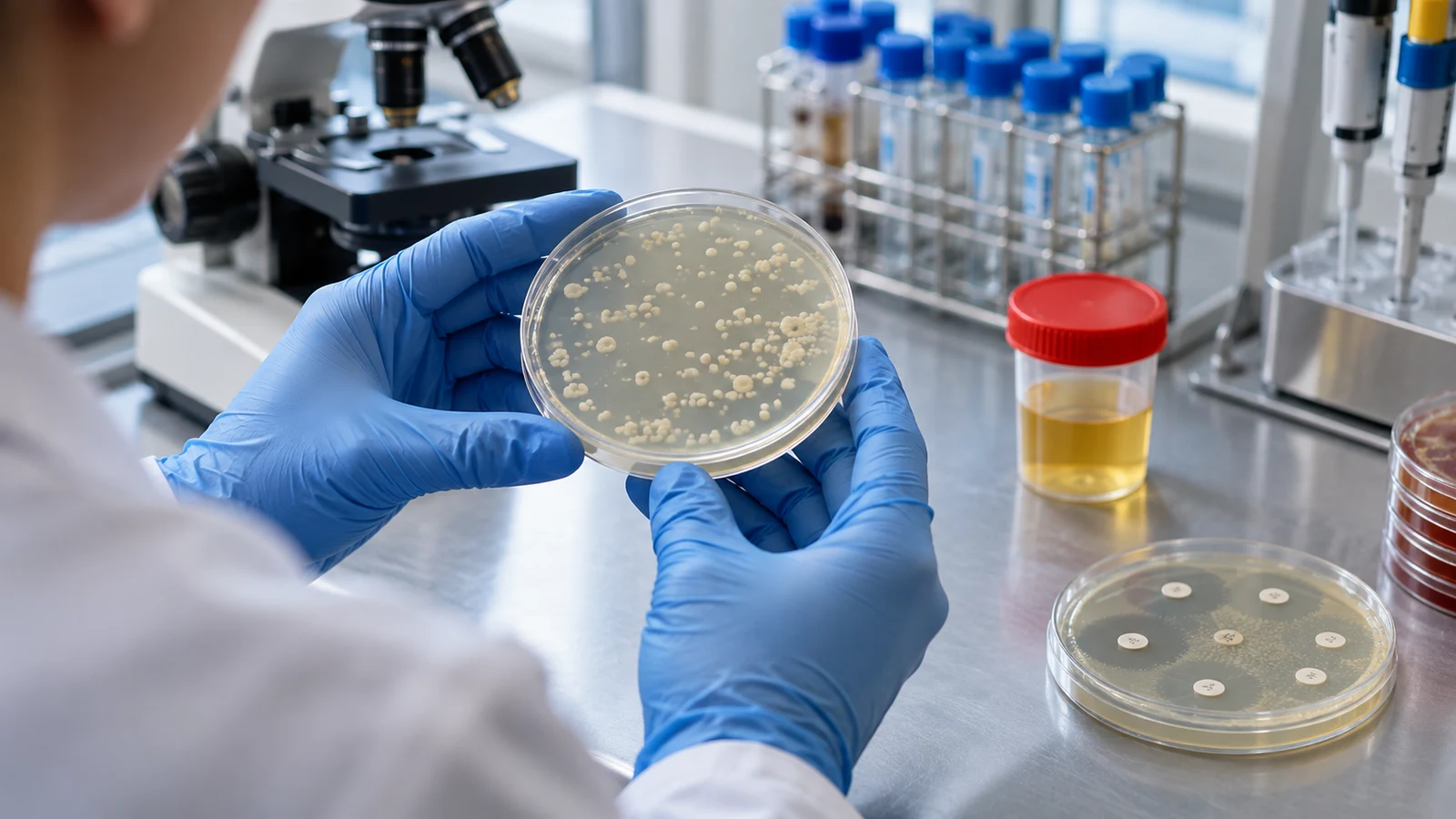
- Antibiogram: Shows which antibiotics are effective against the bacterium that grew. Each drug has the letter S, I, or R next to it.
- What do S, I, R mean? The definitions of the European Committee on Antimicrobial Susceptibility Testing (EUCAST) have been in use since 2019. S means "susceptible, standard dosing." I means "susceptible, increased exposure"; the drug works when given at a higher dose or when it reaches a high concentration at the site of infection. R means "resistant."
- e-Nabız: In e-Nabız (Türkiye's national health record app), the "My Tests" section lists results with reference values; out-of-range values are colored. You can download your results as a PDF and take them to your doctor.
Normal value and reference range
A normal result reads "No growth" or "No significant growth." Which count is significant depends on the person and the type of sample.
| Person or sample | Growth that may be considered significant | Source |
|---|---|---|
| Person without symptoms | ≥10⁵ CFU/mL of a single species; in 2 consecutive samples in women, a single sample in men | IDSA 2019, EAU 2026 |
| Adult woman with symptoms | A count as low as 10² CFU/mL of a single species may be significant | KLİMUD 2020, UKHSA 2025 |
| Adult man | A count as low as 10³ CFU/mL of a pure or predominant bacterium | KLİMUD 2020 |
| Pregnant woman | ≥10⁵ CFU/mL even without symptoms; confirmed with a repeat sample | KLİMUD 2020 |
| Catheter urine | ≥10³ CFU/mL together with symptoms | EAU 2026 |
A reference range covers 95% of healthy people; about 1 in 20 healthy people may fall slightly outside the range. This rule is not applied directly to cultures; the count must always be interpreted together with symptoms.
According to KLİMUD, pure growth between 10⁴ and 10⁵ CFU/mL is assessed according to clinical information or confirmed with a repeat culture. In a woman who is not pregnant and has no symptoms, growth below 10⁵ is rarely persistent; it is usually contamination.
What does it mean if it is high?
If there is growth in the culture, the possibilities, from common and harmless to serious, are as follows:
- Sample contamination: Growth of three or more species, skin and genital-area bacteria, and low counts suggest contamination. According to KLİMUD, lactobacilli, diphtheroids, and viridans streptococci are generally not considered urinary pathogens.
- Sample left standing: Bacteria multiply in urine left at room temperature. According to UKHSA, this can lead to a false-positive result.
- Asymptomatic bacteriuria (colonization): There are no symptoms, but bacteria grow. EAU 2026 does not recommend screening or treatment in women without risk factors, postmenopausal women, people with well-controlled diabetes, or older adults in care homes.
- Bladder infection (cystitis): Growth together with burning and frequent, urgent urination is significant. According to EAU, most cystitis is caused by E. coli.
- Kidney infection or complicated infection: There is fever, chills, and flank pain. EAU strongly recommends culture and antibiogram in this situation.
- Candida (yeast) growth: Associated with an indwelling catheter; it can also come from the genital area. Your doctor assesses its meaning based on your symptoms.
- Group B streptococcus: According to KLİMUD, it is reported at any count in women of childbearing age. The guideline counts this growth as a panic value in pregnant women at weeks 35–37.
What if there are no symptoms? IDSA and EAU do not recommend treating asymptomatic bacteriuria except in pregnancy and before a urological procedure that injures the mucosa. KLİMUD also states that contamination or colonization does not require treatment if there is no pyuria and no symptoms.
Read together with
- Growth + leukocytes in urine + symptoms: The three elements needed for a true infection are present together. The treatment decision is made in this picture.
- Growth present, no leukocytes, no symptoms: Contamination or colonization is likely; no antibiotic is needed.
- Leukocytes present, no growth: This is called sterile pyuria. Details are in the article on leukocytes in urine.
- Repeated growth of bacteria such as Proteus: According to EAU, stone formation should be investigated.
- Asymptomatic bacteriuria in a young man: EAU recommends considering chronic bacterial prostatitis.
- Mixed growth + symptoms present: According to UKHSA, a small number may be true mixed infections. If symptoms persist, the test is repeated with a new sample.
Preparing for the test
- Give it before antibiotics: Bacteria may not grow in a sample taken after antibiotics have started.
- Sterile container and midstream: Do not touch the inside of the container or its lid. According to KLİMUD, 10–50 mL of midstream urine is collected after the first few mL are discarded.
- Timing: The first morning urine or urine that has stayed in the bladder for at least 2 hours is preferred.
- Cleaning: Clean the area with soapy water and rinse with water. Do not use antiseptics.
- Delivery: Get the sample to the laboratory within 1 hour. If there will be a delay, keep it in the refrigerator for at most 24 hours; do not freeze it.
- In people with a catheter: According to UKHSA, the sample is not taken from the urine bag; it is taken from the catheter's sampling port.
- Time to result: According to KLİMUD, plates are incubated for 16–24 hours. For suprapubic samples, fungal testing, or small colonies, the time extends to 48 hours. Additional time is needed for the antibiogram.
Which doctor, which test?
- Person without symptoms who is not pregnant: Family physician. Treatment is generally not needed. According to EAU, screening cultures are also not recommended in these groups.
- Bladder infection symptoms: Family physician. The drug is chosen according to the antibiogram and your personal characteristics. Not every drug marked S is suitable for everyone.
- Fever and flank pain: Emergency department or infectious diseases. Culture, antibiogram, and imaging if needed are performed.
- Pregnancy: Obstetrics and gynecology. A treatment that is safe in pregnancy is chosen according to the culture result.
- Recurrent infection: Urology. According to UKHSA, 2 episodes in the last 6 months or 3 in the last 12 months count as recurrent infection.
- Planned urological procedure: Urology. According to IDSA, a culture is taken before the procedure and targeted treatment is given according to the result. According to the guideline, treatment is started 30–60 minutes before the procedure.
- Recurrent growth in a man: Urology. An evaluation for prostate and stones is performed.
In Türkiye
- EUCAST standard: According to the 2022–2023 report of the National Antimicrobial Resistance Surveillance (UAMDS) Network of HSGM (the Ministry of Health's General Directorate of Public Health), all laboratories in the network use EUCAST standards. The letters S, I, and R are written according to these definitions.
- National standard: Volume II of the National Microbiology Standards (UMS, 2014) of the Turkish Ministry of Health defines antibiotic susceptibility testing methods and the differences between CLSI and EUCAST.
- Resistance picture: According to the UAMDS report, in 2023, 59% of E. coli grown from blood and cerebrospinal fluid samples were resistant to 3rd-generation cephalosporins. This rate was 52% for fluoroquinolones and 4% for carbapenems. These data are not from urine samples. Still, they show why the antibiogram matters.
- Leftover antibiotics at home: At this level of resistance, a randomly chosen drug may not work. Use antibiotics on your doctor's recommendation.
- Critical value reporting: According to the Ministry's procedure, growth of vancomycin-resistant enterococci (VRE) and Streptococcus agalactiae in any culture is a critical value. The laboratory reports these results to the doctor immediately.
- Turkish definitions: The Turkish Microbiological Society has published Turkish definitions of EUCAST's S, I, and R categories.
When should you seek emergency care?
- If you have fever, chills, back or flank pain, and vomiting, go to the emergency department the same day.
- If there is confusion, shortness of breath, or low blood pressure, call 112 (the emergency number in Türkiye). IDSA recommends starting treatment without delay in a person with fever and signs of severe infection.
- If there is fever, flank pain, or signs of preterm labor during pregnancy, go to the obstetric emergency department.
- If a relative with a catheter has fever or a new change in consciousness, emergency evaluation is needed.
- If the laboratory has called you about a critical value, do what you are told without delay.
Related tests
- Lab Test Guide: all tests
- How to read urinalysis results
- What do leukocytes in urine mean?
- Urinary tract infection guide
- Urinary tract infection after sex
What changed? (October 2026)
- New page. It is consistent with the EAU Guidelines on Urological Infections 2026, IDSA 2019, and EUCAST's S, I, R definitions in use since 2019.
- Turkish resistance data were taken from HSGM's UAMDS 2022–2023 report published in March 2025.
Sources
- Klinik Mikrobiyoloji Uzmanlık Derneği (KLİMUD). Üriner Sistem Örneklerinin Laboratuvar Tanısı Rehberi. 2nd edition, Ver 2.1, 2020. https://www.klimud.org/uploads/content/%C3%9Criner%20Sistem%20%C3%96rneklerinin%20Laboratuvar%20Tan%C4%B1s%C4%B1%20(Ver2.1-2020).pdf (accessed October 2, 2026)
- Nicolle LE, Gupta K, Bradley SF et al. Clinical Practice Guideline for the Management of Asymptomatic Bacteriuria: 2019 Update by the Infectious Diseases Society of America. Clin Infect Dis 2019;68(10):e83-e110. https://doi.org/10.1093/cid/ciy1121 (accessed October 2, 2026)
- European Association of Urology. EAU Guidelines on Urological Infections. 2026 (limited update March 2026). https://uroweb.org/guidelines/urological-infections (accessed October 2, 2026)
- UK Health Security Agency, NHS England. Diagnosis of urinary tract infections: quick reference tools for primary care. Updated July 7, 2025. https://www.gov.uk/government/publications/urinary-tract-infection-diagnosis/diagnosis-of-urinary-tract-infections-quick-reference-tools-for-primary-care (accessed October 2, 2026)
- EUCAST. New definitions of S, I and R from 2019. 2019. https://www.eucast.org/newsiandr (accessed October 2, 2026)
- Türk Mikrobiyoloji Cemiyeti. EUCAST duyurusu: S, I ve R kategorileri. Effective January 1, 2019. https://www.tmc-online.org/userfiles/file/EUCAST_S_I_ve_R_Kategorileri.pdf (accessed October 2, 2026)
- Republic of Türkiye Ministry of Health, General Directorate of Public Health. Ulusal Antimikrobiyal Direnç Sürveyans (UAMDS) Ağı 2022-2023 Yıllık Raporu. March 2025. https://hsgm.saglik.gov.tr/depo/birimler/mikrobiyoloji-referans-laboratuvarlari-ve-biyolojik-urunler-db/Dokumanlar/Raporlar/UAMDS_2022-2023_Yillik_Raporu.pdf (accessed October 2, 2026)
- Republic of Türkiye Ministry of Health, Public Health Institution of Türkiye. Ulusal Mikrobiyoloji Standartları: Bulaşıcı Hastalıklar Laboratuvar Tanı Rehberi, Cilt II. 2014, Publication No. 934. https://hsgm.saglik.gov.tr/depo/birimler/mikrobiyoloji-referans-laboratuvarlari-ve-biyolojik-urunler-db/Dokumanlar/Rehberler/UMS_LabTaniRehberi_Cilt_2.pdf (accessed October 2, 2026)
- Republic of Türkiye Ministry of Health, General Directorate of Health Services. Karar Sınırı (Eşik Değer), Kritik Değer (Panik Değer) ve Ölçüm Birimlerinin Harmonizasyonu Prosedürü. 22.09.2020. https://dosyamerkez.saglik.gov.tr/Eklenti/15143/0/karar-siniri-esik-deger-kriek42009846pdf.pdf (accessed October 2, 2026)
- Republic of Türkiye Ministry of Health. e-Nabız Kullanım Kılavuzu V2.1. 31.05.2025. https://enabiz.gov.tr/document/User_Manual.pdf (accessed October 2, 2026)
Frequently asked questions
What do 100,000 colonies in a urine culture mean?
100,000 colonies means 10⁵ CFU/mL. If you have symptoms, it supports an infection. If you have no symptoms and are not pregnant, it is considered asymptomatic bacteriuria; treatment is generally not needed.
What does mixed growth mean — should I give another sample?
Mixed growth often shows that skin or genital-area bacteria got into the sample. If your symptoms persist, a new sample is given using the clean midstream method. If you have no symptoms, a repeat is generally not needed.
What do S, I, R mean in an antibiogram?
S shows that treatment success with a standard dose is high. I shows that the drug is effective at a higher dose or where it becomes concentrated. R shows that the drug will most likely not work even if you increase the dose.
I have no symptoms, but E. coli grew in the culture — should I take medication?
If you are not pregnant and no urological procedure is planned, generally no. Unnecessary antibiotics increase resistance. Your doctor decides based on your situation.
How many days does a urine culture take?
Culture plates are usually incubated for 16–24 hours. For fungal testing or slow-growing bacteria, this time extends to 48 hours. Additional time is needed for the antibiogram.
What happens if there is growth in a urine culture during pregnancy?
In pregnancy, significant growth is important even without symptoms. IDSA and EAU recommend screening and treatment in pregnancy. According to KLİMUD, growth of ≥10⁵ CFU/mL is confirmed with a repeat sample. Your doctor chooses an antibiotic that is safe in pregnancy.