Guides
How to Read a Supplement Label: Checking the Approval Number
On a food supplement label, look for the daily serving, the mandatory warnings, and Ministry approval. The approval number is checked in GGBS; disease claims are prohibited.
Translated from the Turkish original by DoktorClub. The Turkish version is the reference text; this English translation has not been separately reviewed by a physician. Read the Turkish original.
Key takeaway
On the label, first look for the phrases "food supplement" and "Not a medicine," the daily serving, and the mandatory warnings. The Turkish Food Codex Communiqué on Food Supplements makes this information mandatory. In Türkiye, supplements are sold with the approval of the Ministry of Agriculture and Forestry; you can search approved products in the Food Safety Information System (GGBS) by product name, company name, or approval number. A supplement label that says it prevents or treats a disease breaks the rules.
Short Answer
On the label, first look for the phrases "food supplement" and "Not a medicine," the daily serving, and the mandatory warnings. The Turkish Food Codex Communiqué on Food Supplements makes this information mandatory. In Türkiye, supplements are sold with the approval of the Ministry of Agriculture and Forestry; you can search approved products in the Food Safety Information System (GGBS) by product name, company name, or approval number. A supplement label that says it prevents or treats a disease breaks the rules.
The difference between a food supplement and a medicine
The 2023 health claims regulation of TİTCK (Turkish Medicines and Medical Devices Agency) defines a food supplement as follows: foods prepared to supplement the normal diet, with a set daily intake dose. These products contain vitamins, minerals, plant extracts, or similar substances in capsule, tablet, powder, or liquid form.
The same regulation defines a medicine (medicinal product for human use) as a product that treats or prevents disease. So the difference is not in the name but in the purpose:
- Medicine: Used to treat or prevent disease.
- Food supplement: Supports nutrition; sold with the approval of the Ministry of Agriculture and Forestry.
Being sold in a pharmacy does not make a box a medicine. According to the Ministry, supplements can be sold by any business that sells food. The class a substance falls into can also change; for example, for the current status of melatonin, see the melatonin guide.
What must be on the label
The Turkish Food Codex Communiqué on Food Supplements (No. 2013/49) makes the following information mandatory on the label:
- A name that identifies the product and the phrase "food supplement."
- The daily serving amount recommended by the manufacturer.
- The warning "Do not exceed the recommended daily serving."
- The warning "Food supplements cannot replace a normal diet."
- The warning "Keep out of the reach of children."
- The warning "Not a medicine. Not to be used to prevent or treat diseases."
- The warning "Consult your doctor during pregnancy and breastfeeding, and in case of illness or medication use."
According to the Communiqué, the phrase "Not a medicine" must be printed in a size where the lowercase letter height is at least 3 mm. The amount of each ingredient is given as a number per daily serving. Vitamins and minerals are also shown as a percentage of the nutrient reference value. For substances that have no reference value, "no nutrient reference value" is written.
6 steps for reading the label
- Look at the daily serving: The amounts are for the daily serving, not for a single tablet.
- Check the percentage: The percentage is calculated against the nutrient reference value; this value is not an upper limit. For amounts far above the reference value, consult your doctor. You can compare upper limits with the supplement check tool.
- Add up the same ingredient: If a multivitamin and a single-ingredient product contain the same vitamin, the amounts add up.
- Read the age group: The Ministry requires the product to be used according to the user group on the label: ages 2–4, ages 4–10, age 11 and over. If your child's age does not fit this group, ask your pharmacist.
- Read the warnings: Warnings about pregnancy, breastfeeding, illness, and medication use concern you directly.
- Check the approval: Search for the product in GGBS.
According to the Ministry, no food supplement approval is given for infants and young children under 2 years of age. Ask your pediatrician about every vitamin drop to be used at this age.
How do you check an approval number?
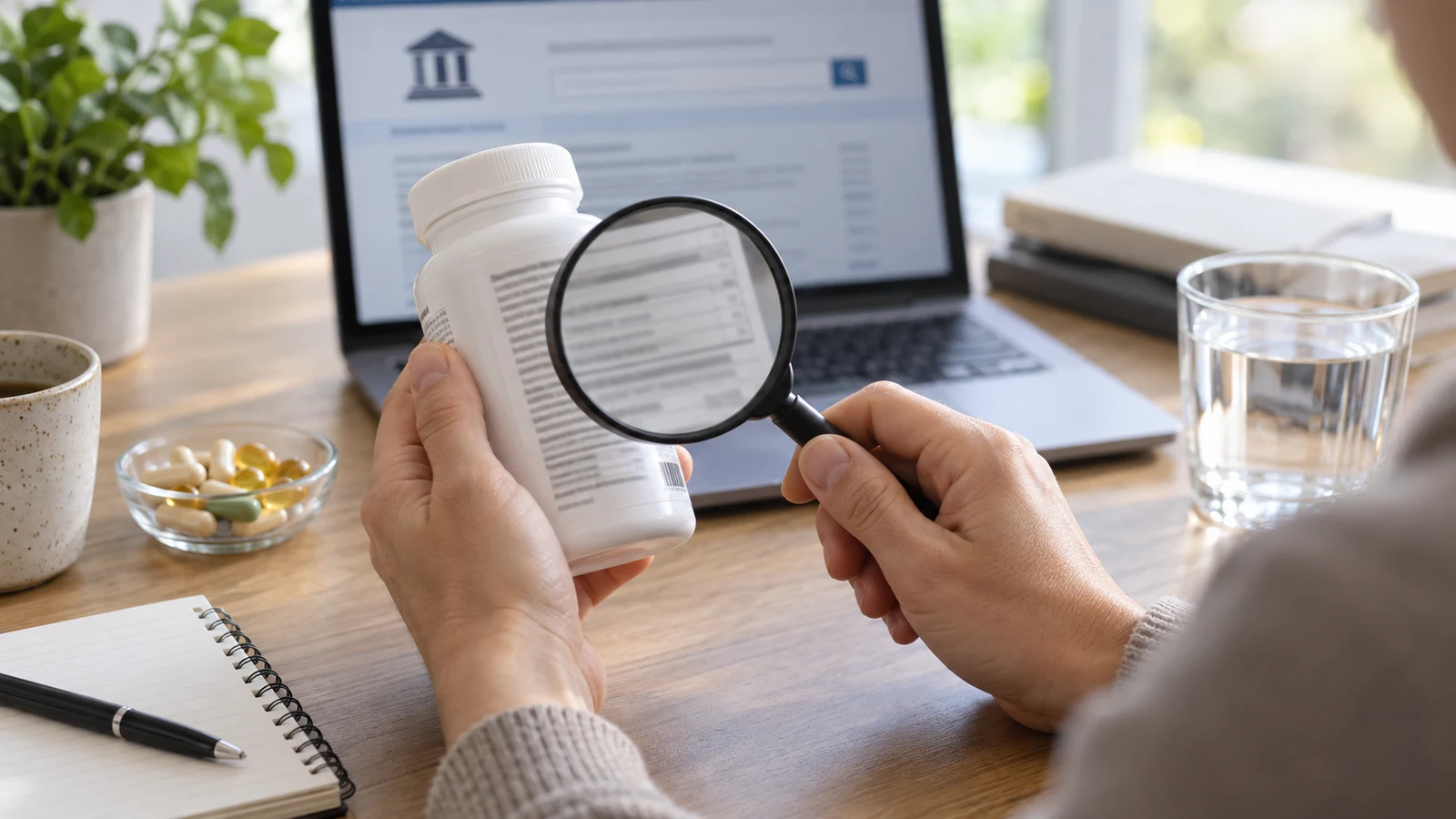
According to the Safe Food page of the Ministry of Agriculture and Forestry, approved supplements are listed in GGBS. To check:
- Go to ggbs.tarim.gov.tr.
- Open the list of approved food supplements.
- Search by manufacturer or importer name, approval number, or product name.
- Check whether the product name and company in the list match the information on the box.
Do not use a product you cannot find in the list, and consult your pharmacist. Being on the list does not by itself prove that the box in your hand is not counterfeit. Do not buy a product whose package has been opened, whose Turkish label is missing, or whose batch number cannot be read.
Health claims: which statements are prohibited?
According to the Communiqué on Food Supplements, the label, presentation, and advertising cannot contain claims of preventing, treating, or curing a disease. Statements implying that an adequate and balanced diet cannot provide the nutrients are also prohibited.
According to the Ministry of Agriculture and Forestry, supplements cannot be placed on the market with the following claims:
- Weight loss
- Increasing sexual performance
- Increasing height
- Intellectual development
- Helping people quit smoking
- Eliminating attention deficit
TİTCK's Regulation on the Use of Health Claims in Foods and Food Supplements (2023) sets additional limits. According to this regulation, the following claims are strictly not allowed:
- Claims suggesting that health will deteriorate if the product is not used.
- Claims stating how much weight will be lost or gained.
- Claims based on personal testimonials, praise, or the endorsement of an organization.
According to the regulation, the claims in the annexes of the relevant guideline can be used without an application; claims outside these are subject to TİTCK assessment. Narrowly scoped claims about reducing disease risk can also be used only under the conditions in the guideline and with an additional statement. Disease claims such as "prevents cancer" or "ends diabetes" cannot appear on a supplement.
Counterfeit and adulterated products
Adulteration is the addition to a product of a substance not stated on the label. The most dangerous adulteration in supplements is a hidden active drug ingredient.
According to an analysis published in JAMA Network Open in 2018, the FDA detected unapproved drug ingredients in 776 supplements between 2007 and 2016. These products were mostly sold for sexual performance, weight loss, and muscle building. The detailed results are in our guide to herbal supplement risks.
The following signs should alert you:
- Claims such as "instant effect," "guaranteed results," or "no side effects."
- Products sold only through social media or by message.
- Boxes without a Turkish label or company information that are not found in GGBS.
- "Herbal" products promising weight loss, sexual power, or muscle building.
Advertising and social media rules
The Regulation on Commercial Advertising and Unfair Commercial Practices was amended in July 2026. The amendment entered into force on August 1, 2026. With this amendment, food supplements were explicitly added to the provision on food advertising.
- Social media influencers: Posts containing advertising must carry the label "Advertisement" or "Promotion."
- Does not replace a normal diet: Supplements cannot be advertised in a way that gives the impression that they replace normal foods.
- Artificial intelligence: If AI characters that cannot be distinguished from humans are used in an advertisement, this must be clearly stated.
An "expert" or a well-known person praising a product does not show that the product is effective or safe.
What does the evidence say?
Supplements are not tested like medicines. According to NIH ODS, in the US medicines receive FDA approval before sale, but supplements do not. Ministry approval in Türkiye also does not show that a product treats disease; the product is not a medicine.
NIH ODS states that independent quality seals also do not guarantee that a product is safe or effective. These seals only indicate manufacturing quality and the accuracy of the contents.
In Türkiye
- List of fraudulent products: Since October 2, 2024, the Ministry of Agriculture and Forestry has been publishing counterfeit and adulterated foods in real time in the "Public Food Announcement" section of the Safe Food website. The list includes the company, brand, product name, type of nonconformity, and batch number.
- Complaint line: The Ministry's reporting and complaint line is the Alo 174 Food Line.
- Regulation in preparation: According to news reports from May 2026, the Turkish Ministry of Health has prepared a draft law on supplements. Under the draft, a commission will decide whether a product will be supervised by the Ministry of Health or the Ministry of Agriculture and Forestry. Currently approved products are expected to reapply within 6 months. The draft is not yet in force; until it is, the current rules apply.
- Melatonin is no longer a supplement: According to a TİTCK letter dated September 2, 2025, supplements containing melatonin cannot be sold since June 9, 2025. The agency classifies these products as medicines (medicinal products for human use); only licensed products can be sold in pharmacies. If you have melatonin labeled as a "supplement," consult your pharmacist.
- Herbal products: We explained the difference between herbal medicines and herbal supplements in our guide to herbal supplement risks.
Which doctor should you see?
- First step: Your pharmacist; check the label and its compatibility with your medicines together.
- If you have a chronic disease: The doctor who follows you (such as Internal Medicine, Cardiology, Endocrinology).
- Pregnancy and breastfeeding: Obstetrics and Gynecology.
- For children: Pediatrics.
- Bring with you: Supplement boxes, a list of the medicines you use, and your latest test results.
When should you seek emergency care?
- If a child has swallowed a product containing iron, call 112 (the emergency number in Türkiye) without waiting for symptoms.
- If a child has swallowed another supplement or medicine, call 114, the National Poison Information Center. If there is drowsiness, vomiting, breathing difficulty, or a seizure, call 112.
- If swelling of the face, lips, or tongue or shortness of breath occurs after a supplement, call 112.
- If palpitations, chest pain, or fainting occurs after a weight-loss or sexual-power product, call 112.
- If yellowing of the eyes, dark urine, or severe abdominal pain occurs while using a supplement, go to the emergency department the same day.
- If yellowing is accompanied by confusion, excessive sleepiness, or bleeding, call 112.
Related guides
- Vitamin and Mineral Guide
- Supplement check tool
- Supplement and drug interactions
- Herbal supplement risks: is natural safe?
- Are antioxidant supplements really necessary?
- Vitamin D excess and toxicity
What changed? (October 2026)
- New guide: the amendment to the advertising regulation that entered into force on August 1, 2026 was added.
- The supplement regulation preparations that became public in May 2026 were summarized, noting that they are not in force.
- The Alo 174 Food Line was added for reporting suspicious products.
- It was added that melatonin cannot be sold as a supplement since June 9, 2025.
Sources
- Ministry of Food, Agriculture and Livestock. Türk Gıda Kodeksi Takviye Edici Gıdalar Tebliği (Tebliğ No 2013/49). Official Gazette 16.08.2013, issue 28737 (as amended). https://www.resmigazete.gov.tr/eskiler/2013/08/20130816-16.htm (accessed October 4, 2026)
- Ministry of Agriculture and Forestry, Güvenilir Gıda. Takviye Edici Gıda. 2026. https://guvenilirgida.tarimorman.gov.tr/Sayfa/Detay/1882 (accessed October 4, 2026)
- TİTCK. Gıda ve Takviye Edici Gıdalarda Sağlık Beyanı Kullanımı Hakkında Yönetmelik. Official Gazette 20.04.2023, issue 32169. https://www.resmigazete.gov.tr/eskiler/2023/04/20230420-5.htm (accessed October 4, 2026)
- Ministry of Trade. Ticari Reklam ve Haksız Ticari Uygulamalar Yönetmeliğinde Değişiklik Yapılmasına Dair Yönetmelik. Official Gazette 01.07.2026, issue 33297. https://www.resmigazete.gov.tr/eskiler/2026/07/20260701-9.htm (accessed October 4, 2026)
- Ministry of Agriculture and Forestry. Taklit ve hileli gıda listeleri artık anlık paylaşılacak. October 1, 2024. https://www.tarimorman.gov.tr/Haber/6409/Taklit-Ve-Hileli-Gida-Listeleri-Artik-Anlik-Paylasilacak (accessed October 4, 2026)
- Türkiye Gazetesi. Takviye edici gıdalarda izinler sil baştan: çifte bakanlık denetimi geliyor. May 14, 2026. https://www.turkiyegazetesi.com.tr/ekonomi/takviye-edici-gidalarda-izinler-sil-bastan-cifte-bakanlik-denetimi-geliyor-1790401 (accessed October 4, 2026)
- Republic of Türkiye Ministry of Health. 114 UZEM (Ulusal Zehir Danışma Merkezi) çağrı merkezi. 2026. https://www.saglik.gov.tr/TR,11518/114-uzem.html (accessed October 4, 2026)
- Tucker J et al. Unapproved pharmaceutical ingredients included in dietary supplements associated with US Food and Drug Administration warnings. JAMA Netw Open 2018;1(6):e183337. https://doi.org/10.1001/jamanetworkopen.2018.3337 (accessed October 4, 2026)
- NIH Office of Dietary Supplements. Dietary Supplements: What You Need to Know. Updated January 4, 2023. https://ods.od.nih.gov/factsheets/WYNTK-Consumer/ (accessed October 4, 2026)
- Turkish Medicines and Medical Devices Agency. Melatonin içeren takviye edici gıdaların satışının yapılmaması hakkında (letter no. E-24931227-520.99-572252; announcement of the Antalya Chamber of Pharmacists). September 2, 2025. https://www.antalyaeo.org.tr/tr/m/turkiye-ilac-ve-tibbi-cihaz-kurumu/melatonin-iceren-takviye-edici-gidalarin-satisinin-yapilmamasi-hakkinda.html (accessed October 4, 2026)
Frequently asked questions
How can you tell whether a supplement is genuine?
Search for the product in the list of approved supplements in GGBS by product name, company, or approval number. Check that the mandatory warnings on the label are complete. Being on the list does not rule out counterfeit packaging; show a product you are suspicious of to your pharmacist or report it to Alo 174.
Is a supplement sold in a pharmacy a medicine?
No. The place of sale does not change the type of product. Food supplement labels must state "Not a medicine."
The label says "strengthens immunity" — is that correct?
The permitted claim wording is of the type "contributes to the normal function of the immune system." According to the TİTCK regulation, equivalent wording cannot strengthen the meaning of the claim. For this reason, wording such as "strengthens" falls outside this template. Claims of preventing disease are entirely prohibited.
Is it safe to buy supplements online?
It is risky. According to a 2018 analysis based on FDA data in the US, 38.6% of samples containing hidden drugs in 2014–2016 were products bought online. Stay away from products not found in GGBS and sold only through social media. Do not use a product without checking it in GGBS.
Can I use a supplement together with my medicine?
Some supplements change the absorption and effect of medicines. The label also asks people who use medicines to consult a doctor. For details, see our guide to supplement–drug interactions.