Guides
Ovulation Tests and LH: When to Test and How to Read the Result
An ovulation test detects the LH surge in urine; ovulation usually occurs within the next 2 days. The right days, causes of false positives and next steps.
Translated from the Turkish original by DoktorClub. The Turkish version is the reference text; this English translation has not been separately reviewed by a physician. Read the Turkish original.
Key takeaway
An ovulation test detects the sudden surge of the hormone LH in urine; according to ASRM 2022, ovulation may occur within the next 2 days. Because the most fertile period is the 6-day window ending on the day of ovulation, there is no need to wait for a positive result to have intercourse. The test does not prove ovulation and can give false positives in conditions such as PCOS. If you have a blood LH result, the laboratory's own range applies.
Short Answer
An ovulation test detects the sudden surge of the hormone LH in urine; according to ASRM 2022, ovulation may occur within the next 2 days. Because the most fertile period is the 6-day window ending on the day of ovulation, there is no need to wait for a positive result to have intercourse. The test does not prove ovulation and can give false positives in conditions such as PCOS. If you have a blood LH result, the laboratory's own range applies.
How does it appear on your report?
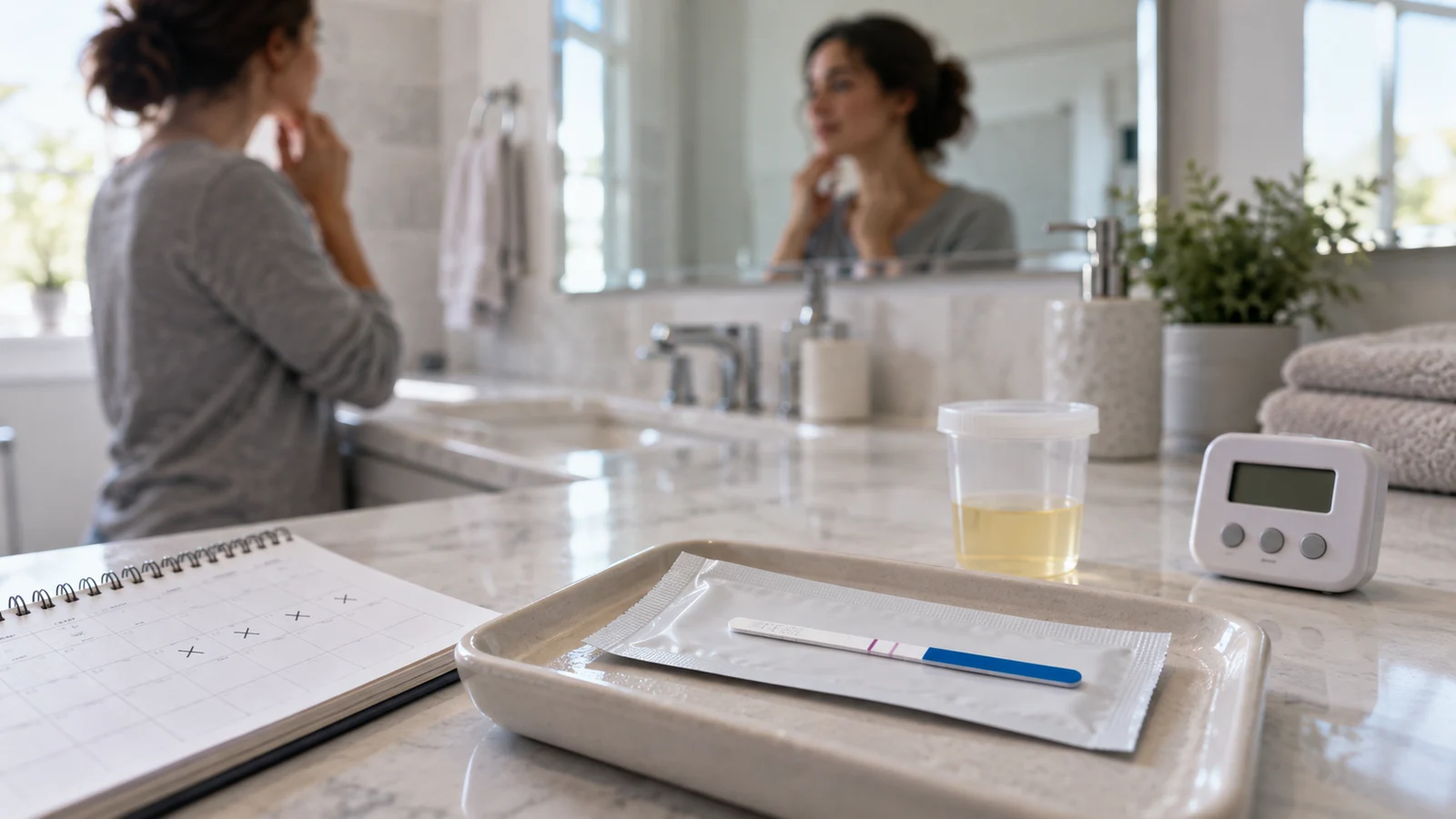
- Home test: The result is read from the lines on the test stick. The reading rule varies by brand; follow the instructions in the box.
- Blood test: It appears on the laboratory report as "Luteinizing hormone (LH)." The unit is IU/L or mIU/mL; the number is the same.
- Phase ranges: Laboratories may give separate LH ranges for the follicular, ovulatory and luteal phases.
The "Tahlillerim" (My Lab Tests) screen in e-Nabız (Türkiye's national health record app) lists laboratory results with their reference values and color-codes values outside the range. A high LH in blood drawn on the day of ovulation may therefore appear colored, but it is normal.
Normal value and reference range
| Cycle phase | Example blood LH value (IU/L) | Note |
|---|---|---|
| Follicular phase | 2.4–12.6 | First half of the cycle |
| Ovulation period | 14.0–95.6 | LH surge |
| Luteal phase | 1.0–11.4 | After ovulation |
| Postmenopausal | 7.7–58.5 | Range higher than the follicular phase |
Source: University of Iowa Health Care laboratory. Your own laboratory's range may differ.
A reference range covers 95% of healthy people; about 1 in 20 healthy people may fall slightly outside the range.
When to start testing, and how to do it?
- Estimate your ovulation day: According to ASRM 2022, the luteal phase is taken to be about 14 days. On this basis, in a 28-day cycle ovulation is around day 14, and in a 30-day cycle around day 16.
- Fertile window: The estimated ovulation day and the 5 days before it. In a 28-day cycle, this corresponds to roughly days 9–14. It makes sense to start testing at the beginning of this window.
- Time of day: According to ASRM 2021, the result agrees better with blood LH in tests done on midday or evening urine.
- Positive result: The LH surge is seen 1–2 days before ovulation. According to ASRM, the highest chance of pregnancy is achieved with intercourse within the 2 days before ovulation.
- Calendar apps: In a 949-person study cited by ASRM, apps predicted the day of ovulation with at most 21% accuracy. Because cycles vary, an app alone is not sufficient.
- Cervical mucus: The probability of pregnancy is highest when slippery, clear mucus is present. However, this mucus is not a requirement for pregnancy.
Frequency of intercourse: Should you wait for a positive test?
No. NICE NG257 (March 2026) states that vaginal intercourse every 2–3 days maximizes the chance of pregnancy. According to ASRM, intercourse every 1–2 days during the fertile window gives the highest rate. Intercourse 2–3 times a week provides almost the same result. It is a common misconception that frequent intercourse lowers male fertility.
According to ASRM, in one randomized study, use of ovulation tests shortened the time to pregnancy. Even if you do not use the test, the regular intercourse recommended by NICE is an adequate approach.
Lubricants: According to ASRM, some water-based lubricants reduce sperm motility by 60–100% within 60 minutes in the laboratory. This effect was not seen with mineral oil and hydroxyethylcellulose-based products.
What does it mean if it is high (positive)?
- Normal LH surge: Ovulation is most likely within the next 1–2 days.
- False positive: According to ASRM 2022, false positive results are seen in about 7% of cycles.
- PCOS: According to ASRM 2021, basal LH may be persistently high in PCOS and the test may give a false positive. TEMD 2025 (Society of Endocrinology and Metabolism of Turkey) also states that average LH is increased in PCOS.
- Approaching menopause and menopause: After menopause, blood LH stays in a range higher than the follicular phase; an example range is 7.7–58.5 IU/L. During this period, a home test can be misleading.
A positive test is indirect evidence of ovulation. According to ASRM, blood progesterone can be checked about 1 week before the next period to confirm ovulation. A value above 3 ng/mL indicates that ovulation has occurred.
What does it mean if it is low (never positive)?
- Timing: The testing days may have missed the surge. Increase the number of testing days, especially if your cycle is variable.
- Ovulation may not have occurred that month: According to ASRM 2021, the most common causes are PCOS, obesity, the menopausal transition, weight change, excessive exercise, thyroid disorders and high prolactin.
- Irregular cycle: According to the 2023 International PCOS Guideline, in adults a cycle shorter than 21 days, longer than 35 days, or fewer than 8 cycles a year is considered irregular. The guideline recommends assessment for PCOS in this case.
- Sporadic anovulation: According to ASRM 2021, occasional anovulatory cycles occur at a rate of 1–14% in women with regular periods.
When read together
- Positive LH test + progesterone 1 week later: According to ASRM, this blood test confirms ovulation. See Progesterone Level.
- Frequent positive tests + irregular periods + acne or excess hair growth: Assessment for PCOS is needed. The LH/FSH ratio, however, is not a diagnostic criterion. See FSH and LH Values.
- Never positive + irregular periods: FSH, LH, prolactin and TSH may be ordered. See High Prolactin.
- Late period: Take a pregnancy test. How to read blood beta HCG is covered in the Beta HCG Values article.
- Basal body temperature: According to NICE NG257, it is not recommended because it does not reliably indicate ovulation.
Preparing for the test
- Cycle tracking: Note the start dates of your periods for at least a few months. Your average cycle length determines the testing days.
- Time: Do the test at a similar time every day, preferably in the afternoon or evening.
- Instructions: Follow the instructions in the box for fluid intake, waiting time and reading time.
- Folic acid: The Antenatal Care Management Guideline considers it appropriate for every woman planning a pregnancy to start taking folic acid at least 1 month before pregnancy. Ask your physician about the right dose.
- If blood LH has been ordered: Give blood on the cycle day your physician requested.
Which doctor, which test?
- Obstetrics and Gynecology: The first place to go for irregular periods, tests that never turn positive and difficulty getting pregnant.
- When? According to ASRM, infertility is the failure to become pregnant after 12 months or more of regular unprotected intercourse. At age 35 and over, assessment is recommended after 6 months.
- NICE NG257 data: More than 80% of couples in which the woman is under 40 become pregnant within 1 year with regular intercourse.
- Tests that may be ordered: Mid-luteal progesterone, FSH, LH, prolactin and TSH. Semen analysis for the male partner is also part of the assessment.
- Endocrinology: You may be referred if PCOS, a thyroid problem or a prolactin problem is suspected.
In Türkiye
- Preparing for pregnancy: The Turkish Ministry of Health's Antenatal Care Management Guideline recommends starting folic acid at least 1 month before pregnancy. The first pregnancy follow-up visit takes place in the first 14 weeks.
- PCOS prevalence: In the Turkish study cited by TEMD 2025, PCOS prevalence was 19.9% by the Rotterdam criteria.
- New name: With an international consensus published in May 2026, PCOS was renamed "polyendocrine metabolic ovarian syndrome (PMOS)." The consensus provides for a transition period; Turkish-language sources such as TEMD 2025 use the name PCOS.
- e-Nabız: You can see your LH, FSH and progesterone results from the laboratory together with their dates.
When to seek emergency care?
- If you have a positive pregnancy test and severe abdominal or groin pain, a feeling of fainting or shoulder-tip pain, call 112 (the emergency number in Türkiye) or go to the emergency department.
- If heavy bleeding occurs with a positive pregnancy test, go to the emergency department.
- If very severe, one-sided groin pain starting mid-cycle does not go away or is accompanied by fever, get examined the same day.
- If the laboratory or your physician has called you about your result, call back the same day.
- If you have not had a period for more than three months, it is not an emergency, but make an appointment soon.
Related tests
- Lab Test Guide: all tests
- FSH and LH Values
- Progesterone Level
- Beta HCG Values
- First-Week Pregnancy Symptoms and Implantation Bleeding
- Signs of Ovulation in PCOS
- How Can You Tell Ovulation Is Occurring in PCOS?
What changed? (October 2026)
- New page: based on the NICE NG257 (March 31, 2026) fertility guideline and the ASRM 2022 opinion on natural fertility.
- The renaming of PCOS as "PMOS" in May 2026 (Lancet consensus report) was noted.
Sources
- Türkiye Endokrinoloji ve Metabolizma Derneği (TEMD). Adrenal ve Gonadal Hastalıklar Kılavuzu. 2025. https://file.temd.org.tr/Uploads/publications/guides/documents/AdrenalKilavuz2025.pdf (accessed October 2, 2026)
- T.C. Sağlık Bakanlığı Halk Sağlığı Genel Müdürlüğü. Doğum Öncesi Bakım Yönetim Rehberi. 2018, Publication No 925. https://platform.who.int/docs/default-source/mca-documents/policy-documents/guideline/TUR-MN-21-01-GUIDELINE-2018-tur-Antenatal-Care-Management-Guidelines.pdf (accessed October 2, 2026)
- Demir SC, Polat İ, Şahin D et al. PERİDER-TJOD düşük tehdidi ve tedavisi kılavuzu. Turk J Obstet Gynecol 2025;22:96-105. https://doi.org/10.4274/tjod.galenos.2025.36926 (accessed October 2, 2026)
- T.C. Sağlık Bakanlığı. e-Nabız Kullanım Kılavuzu V2.1. 2025. https://enabiz.gov.tr/document/User_Manual.pdf (accessed October 2, 2026)
- Practice Committee of the American Society for Reproductive Medicine. Optimizing natural fertility: a committee opinion. Fertil Steril 2022;117:53-63. https://doi.org/10.1016/j.fertnstert.2021.10.007 (accessed October 2, 2026)
- Practice Committee of the American Society for Reproductive Medicine. Fertility evaluation of infertile women: a committee opinion. Fertil Steril 2021;116:1255-1265. https://doi.org/10.1016/j.fertnstert.2021.08.038 (accessed October 2, 2026)
- NICE. Fertility problems: assessment and treatment (NG257). March 31, 2026. https://www.nice.org.uk/guidance/ng257 (accessed October 2, 2026)
- Teede HJ et al. Recommendations From the 2023 International Evidence-based Guideline for the Assessment and Management of Polycystic Ovary Syndrome. J Clin Endocrinol Metab 2023;108(10):2447-2469. https://doi.org/10.1210/clinem/dgad463 (accessed October 2, 2026)
- Teede HJ, Khomami MB, Morman R et al. Polyendocrine metabolic ovarian syndrome, the new name for polycystic ovary syndrome: a multistep global consensus process. Lancet 2026. https://doi.org/10.1016/S0140-6736%2826%2900717-8 (accessed October 2, 2026)
- University of Iowa Health Care. Pathology Laboratory Handbook: Luteinizing Hormone (LH). Current version. https://www.healthcare.uiowa.edu/path_handbook/handbook/test1256.html (accessed October 2, 2026)
Frequently asked questions
My ovulation test was positive. When should I have intercourse?
The 1–2 days after a positive result are a good time. However, the most fertile days are the days before ovulation. That is why ASRM recommends intercourse every 1–2 days throughout the fertile window, and NICE generally recommends every 2–3 days.
Why is my ovulation test positive every day?
If the LH level is persistently high, the test may appear positive every day. According to ASRM, basal LH may be persistently high in PCOS. After menopause, LH also stays in a higher range. Your physician evaluates this based on your menstrual history and blood tests.
How many days after ovulation should I take a pregnancy test?
Take the test once your period is late. According to the PERİDER-TJOD guideline, a small amount of implantation bleeding may occur 10–14 days after fertilization. If the test is negative but your period is still late, repeat it a few days later; details are in the Beta HCG Values article.
My ovulation test is positive but I can't get pregnant. Why?
A positive test does not prove ovulation; according to ASRM, false positives are seen in about 7% of cycles. Even if ovulation occurs, tubal, sperm or other factors may play a role. Ask for an assessment after 12 months if you are under 35, or after 6 months if you are 35 or older.
Is a blood LH value the same as a home test?
Both measure LH but are used for different purposes. A home test catches the day of the surge. Blood LH, on the other hand, is ordered together with FSH to understand hormonal balance when periods are irregular.
Source: Türkiye Endokrinoloji ve Metabolizma Derneği (TEMD). Adrenal ve Gonadal Hastalıklar Kılavuzu. 2025.