Science News
2026 Nobel Prize in Medicine goes to optogenetics: Deisseroth, Hegemann and Nagel
The 2026 Nobel Prize in Physiology or Medicine was announced on October 5, 2026. The prize was awarded jointly to three scientists: Karl Deisseroth, Peter Hegemann and Georg Nagel. The citation was for discoveries concerning light-gated ion channels and optogenetics…
Translated from the Turkish original by DoktorClub. The Turkish version is the reference text; this English translation has not been separately reviewed by a physician. Read the Turkish original.
Key takeaway
The 2026 Nobel Prize in Physiology or Medicine was announced on October 5, 2026. The prize was awarded jointly to three scientists: Karl Deisseroth, Peter Hegemann and Georg Nagel. The citation was for their discoveries concerning light-gated ion channels and optogenetics (press release of the Nobel Assembly at Karolinska Institutet).
Short Answer
The 2026 Nobel Prize in Physiology or Medicine was announced on October 5, 2026. The prize was awarded jointly to three scientists: Karl Deisseroth, Peter Hegemann and Georg Nagel. The citation was for their discoveries concerning light-gated ion channels and optogenetics (press release of the Nobel Assembly at Karolinska Institutet).
Who won the prize?
The Nobel Assembly divided the prize equally among three people:
- Karl Deisseroth (born 1971): Howard Hughes Medical Institute and Stanford University, USA. Professor of bioengineering and of psychiatry and behavioral sciences.
- Peter Hegemann (born 1954): Humboldt University of Berlin, Germany. The prize-winning discoveries were made at the Max Planck Institute of Biochemistry in Martinsried.
- Georg Nagel (born 1953): University of Würzburg, Germany. The prize-winning discoveries were made at the Max Planck Institute of Biophysics in Frankfurt.
The prize amount is 12 million Swedish kronor. The amount will be divided equally among the three scientists.
What was the discovery? From an alga swimming toward light to the brain
The story began with a simple question. Hegemann wondered how Chlamydomonas, a single-celled alga, swims toward light.
In the early 2000s, Hegemann and Nagel found a protein called "channelrhodopsin" on the surface of this alga. When blue light strikes this protein, a channel opens. Charged particles (ions) enter the cell and an electrical signal is generated.
The two researchers saw something else important. Whatever cell the protein was placed in, that cell became sensitive to light.
What did Deisseroth do?
Deisseroth inserted the channelrhodopsin gene into rat nerve cells. By illuminating the cells with blue light, he was able to trigger nerve signals. He published this result in 2005.
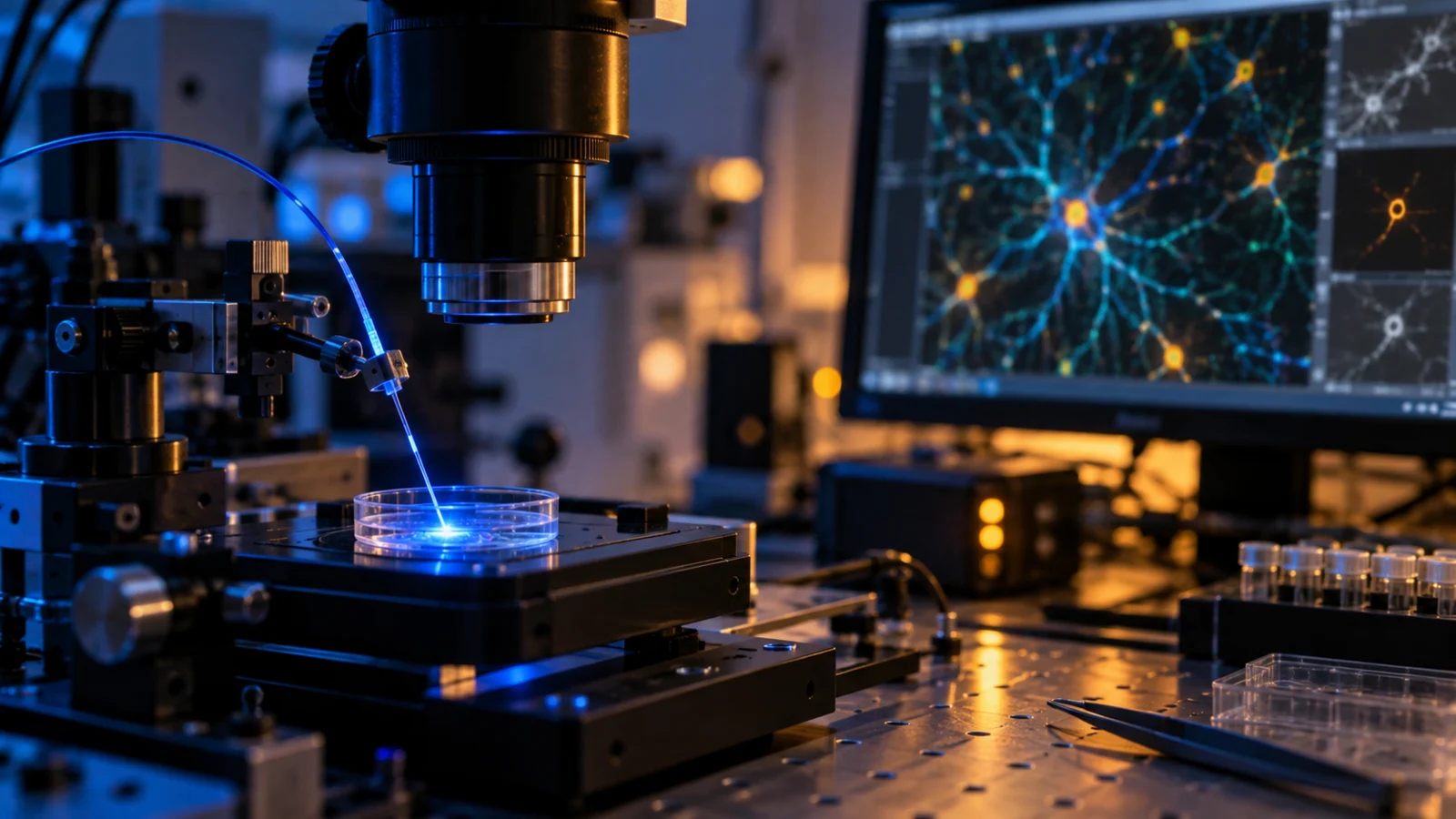
Two years later, the same "light switch" also worked in the brains of living mice. This method of controlling nerve signals with light is now called optogenetics.
Why is optogenetics important?
For a long time, scientists could only indirectly guess which brain region controlled which function. Proving cause and effect was difficult.
Optogenetics made it possible to switch specific nerve cells on and off in the living brain. This allowed researchers to reveal circuits related to:
- How specific memories are formed
- Which neural networks control emotions and behaviors
- Circuits associated with neurological and psychiatric diseases
Per Svenningsson, Chair of the Nobel Committee, said the method has made it possible to map the brain in ways that could once only be imagined.
What does it mean for patients?
Today, optogenetics is mainly a research tool. According to the Nobel Assembly, in clinical medicine researchers are using the method in attempts to restore vision in people with visual impairment.
These studies have not yet become a routine treatment. People experiencing vision loss should discuss their treatment options with their eye doctors.
Frequently Asked Questions
Who won the 2026 Nobel Prize in Medicine?
Karl Deisseroth (Stanford University, USA), Peter Hegemann (Humboldt University of Berlin) and Georg Nagel (University of Würzburg) jointly won the prize.
What work was the prize awarded for?
It was awarded for the discovery of light-gated ion channels and optogenetics. This is exactly the Assembly's citation.
What is optogenetics?
It is a method based on inserting a light-sensitive protein into nerve cells. This allows these cells to be switched on and off with light.
Where did channelrhodopsin come from?
From the single-celled alga Chlamydomonas. The alga uses this protein to swim toward light.
Is optogenetics used in treatment today?
The method is essentially a research tool. Clinical attempts to restore vision are ongoing; it is not a routine treatment.
Sources
- Nobel Assembly at Karolinska Institutet. Press release: The Nobel Prize in Physiology or Medicine 2026. https://www.nobelprize.org/prizes/medicine/2026/press-release/
- NobelPrize.org. The Nobel Prize in Physiology or Medicine 2026 — Summary. https://www.nobelprize.org/prizes/medicine/2026/summary/
- NobelPrize.org. Popular information: A light-sensitive algal protein energised neuroscience. https://www.nobelprize.org/prizes/medicine/2026/popular-information/
- NobelPrize.org. Advanced information: Scientific background 2026. https://www.nobelprize.org/prizes/medicine/2026/advanced-information/
- CNN. Nobel Prize in medicine awarded to three scientists for their work concerning light-gated ion channels and optogenetics (October 5, 2026). https://www.cnn.com/2026/10/05/science/nobel-prize-medicine-karl-deisseroth-peter-hegemann-georg-nagel-intl
Frequently asked questions
Who won the 2026 Nobel Prize in Medicine?
Karl Deisseroth (Stanford University, USA), Peter Hegemann (Humboldt University of Berlin) and Georg Nagel (University of Würzburg) jointly won the prize.
What work was the prize awarded for?
It was awarded for the discovery of light-gated ion channels and optogenetics. This is exactly the Assembly's citation.
What is optogenetics?
It is a method based on inserting a light-sensitive protein into nerve cells. This allows these cells to be switched on and off with light.
Where did channelrhodopsin come from?
From the single-celled alga Chlamydomonas. The alga uses this protein to swim toward light.
Is optogenetics used in treatment today?
The method is essentially a research tool. Clinical attempts to restore vision are ongoing; it is not a routine treatment.