Guides
Vitamin A Deficiency and Excess: Retinol and Beta-Carotene
Vitamin A deficiency causes night blindness; excess can harm the liver, the bones and, in pregnancy, the baby. The difference between retinol and beta-carotene, and upper limits.
Translated from the Turkish original by DoktorClub. The Turkish version is the reference text; this English translation has not been separately reviewed by a physician. Read the Turkish original.
Key takeaway
The earliest sign of vitamin A deficiency is night blindness; deficiency is rare in adults who eat a varied diet. Excess, on the other hand, almost always comes from high-dose supplements or frequently eating liver, and it can harm the liver, the bones and, in pregnancy, the baby. This risk applies to preformed vitamin A (retinol); the beta-carotene in vegetables does not cause birth defects. According to EFSA 2024, the upper limit for total retinol from food and supplements is 3,000 µg per day for adults and pregnant women. During pregnancy, do not use supplements containing retinol unless your physician recommends them.
Short Answer
The earliest sign of vitamin A deficiency is night blindness; deficiency is rare in adults who eat a varied diet. Excess, on the other hand, almost always comes from high-dose supplements or frequently eating liver, and it can harm the liver, the bones and, in pregnancy, the baby. This risk applies to preformed vitamin A (retinol); the beta-carotene in vegetables does not cause birth defects. According to EFSA 2024, the upper limit for total retinol from food and supplements is 3,000 µg per day for adults and pregnant women. During pregnancy, do not use supplements containing retinol unless your physician recommends them.
What does it do?
According to NIH ODS, vitamin A is a key component of rhodopsin, the substance in the eye that detects light. For this reason, it contributes to the maintenance of normal vision. It also plays a role in immune function, growth and development, and reproductive health. It is involved in the normal formation of organs such as the heart, lungs and eyes.
The two forms behave differently in the body:
- Retinol (preformed vitamin A): Found in liver, milk, butter, cheese and eggs. It is stored in the body, mostly in the liver. Excess can be toxic.
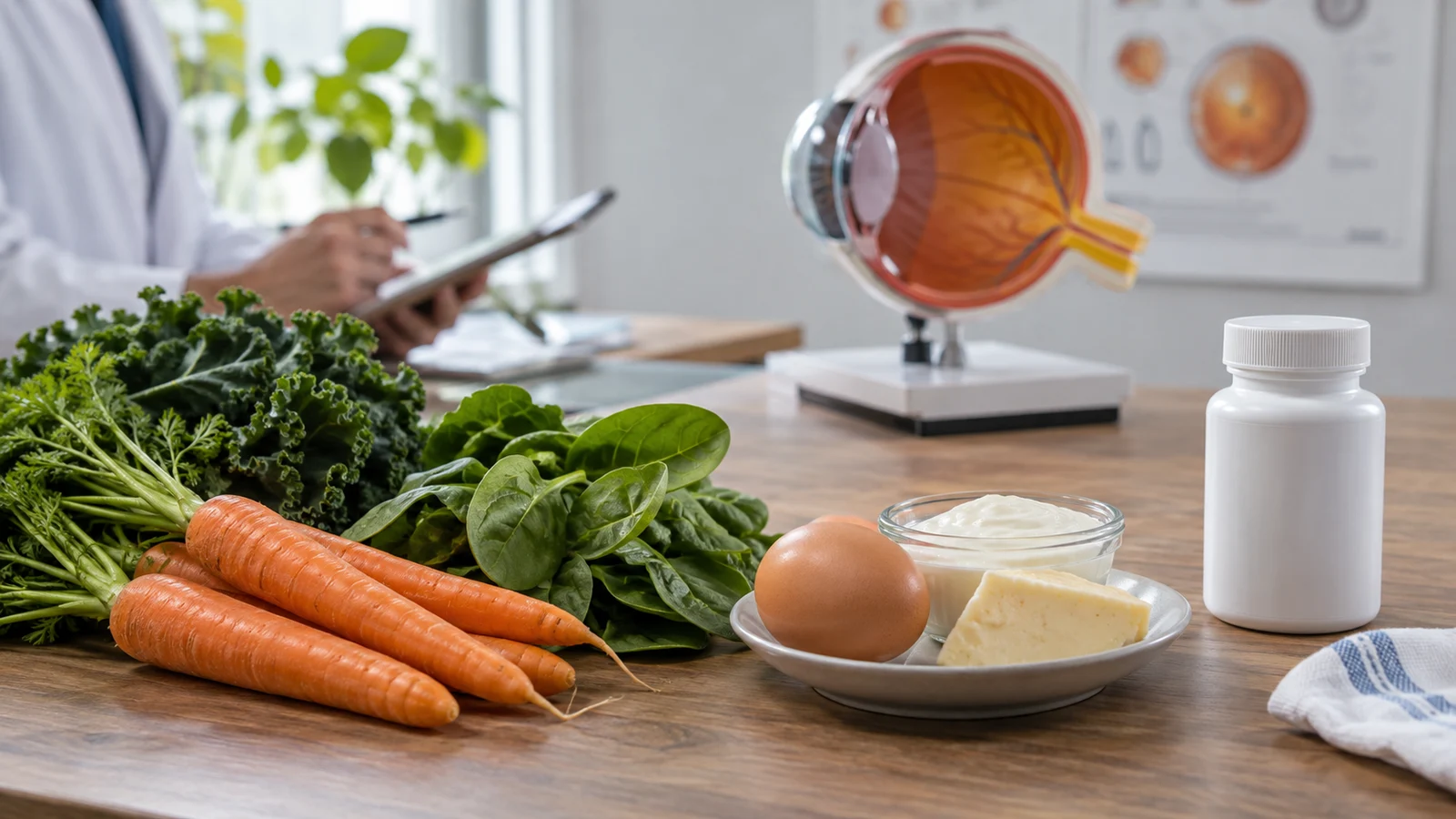
- Beta-carotene (provitamin A): Found in carrots, spinach and orange fruits. The body converts part of it into vitamin A in the intestine. According to NIH ODS, beta-carotene does not cause birth defects the way preformed vitamin A does.
Daily requirement
Requirements vary by age and sex. The values are for healthy people. The unit used is retinol equivalents (µg RE or RAE).
| Group | TÜBER 2022 / EFSA (µg RE/day) | NIH ODS / IOM (µg RAE/day) |
|---|---|---|
| Adult men | 750 | 900 |
| Adult women | 650 | 700 |
| Pregnancy | 700 | 770 |
| Breastfeeding | 1,300 | 1,300 |
The values of the two bodies differ slightly. If you see IU on labels, according to NIH ODS 1 IU of retinol is 0.3 µg RAE. So 3,000 µg corresponds to about 10,000 IU of retinol.
Which foods contain it?
According to TÜBER 2022 (the Turkish Dietary Guidelines), sources of retinol are liver, milk and dairy products, and margarine fortified with vitamin A. Sources of beta-carotene are orange and green leafy vegetables and fruits such as carrots, apricots and spinach. According to NIH ODS, eggs also contain preformed vitamin A.
Some examples from the NIH ODS food table:
- Beef liver (about 85 g, pan-fried): 6,582 µg RAE. This is more than twice the adult upper limit.
- Spinach (half a cup, boiled): 573 µg RAE.
- Carrots (half a cup, raw): 459 µg RAE.
- Egg (1 large, hard-boiled): 75 µg RAE.
Liver is a popular dish, but it is very rich in vitamin A. According to EFSA 2024, if liver and offal are eaten once a month or less often, the upper limit is not exceeded. EFSA advises women who are pregnant or planning a pregnancy not to eat liver products.
Who is at risk of deficiency?
Deficiency is rare in healthy adults who eat a varied diet. According to NIH ODS, the risk groups are:
- Premature infants; their liver stores are low.
- People with cystic fibrosis; according to NIH ODS, up to 90% of these patients have pancreatic insufficiency.
- People with inflammatory bowel diseases such as Crohn's disease and ulcerative colitis.
- Newly diagnosed celiac patients.
- Children living in low- and middle-income countries. According to NIH ODS, in 2013, 29% of children aged 6 months to 5 years in these countries were deficient.
Possible symptoms: According to TÜBER 2022, these are night blindness and other eye problems, dry skin and loss of appetite. According to NIH ODS, chronic deficiency also increases the severity of infections. NIH ODS describes night blindness as the earliest sign. In advanced deficiency, dryness of the eye (xerophthalmia) can progress to blindness. These symptoms also have other causes.
Which test, and how is it read?
Vitamin A status is measured in the blood with serum retinol. According to NIH ODS, 20 µg/dL (0.70 µmol/L) or less usually indicates moderate deficiency. 10 µg/dL or less means severe deficiency.
This test has two important limitations. According to NIH ODS, the blood level does not fall until liver stores are almost depleted. So a normal result does not prove that stores are full. During an infection, on the other hand, the blood level can fall even without deficiency. This test is usually ordered when there is an absorption problem or an eye finding.
The diagnosis of excess relies more on the history. Which product you used, how much and for how long are important. Liver tests and calcium may also be ordered.
When is a supplement needed, and when is it not?
- Healthy adults: USPSTF 2022 recommends against beta-carotene supplements for the prevention of heart disease and cancer (grade D).
- Smokers: According to EFSA 2024, smokers should avoid supplements containing beta-carotene. In the ATBC study, the risk of lung cancer in smokers increased by 18%. In the CARET study, the risk increased by 28% and death from lung cancer by 46%.
- Pregnant women: The WHO 2011 guideline does not recommend vitamin A supplementation in pregnancy as part of routine care. It recommends it only in regions where deficiency is a serious public health problem, to prevent night blindness.
- People with malabsorption: A supplement may be needed; the physician determines the dose.
In short, there is no proven benefit of vitamin A or beta-carotene supplements for an adult without demonstrated deficiency.
Upper limit and excess
According to the EFSA 2024 opinion, the daily upper limits for preformed vitamin A (retinol) are as follows:
| Group | Daily upper limit | Source |
|---|---|---|
| Age 1–3 | 800 µg RE | EFSA 2024 |
| Age 4–6 | 1,100 µg RE | EFSA 2024 |
| Age 7–10 | 1,500 µg RE | EFSA 2024 |
| Age 11–14 / age 15–17 | 2,000 / 2,600 µg RE | EFSA 2024 |
| Adults, pregnant and breastfeeding women | 3,000 µg RE | EFSA 2024 |
EFSA was unable to set an upper limit for beta-carotene. According to EFSA, harm from beta-carotene consumed in foods has not been shown.
The upper limit applies to total retinol from food and supplements. EFSA set this limit based on the risk of birth defects in the baby. According to NIH ODS, high-dose vitamin A can cause defects of the eyes, skull, lungs and heart. NIH ODS recommends that women who are pregnant, who may become pregnant or who are breastfeeding do not take supplements above 3,000 µg RAE (10,000 IU) per day. The UK National Health Service (NHS) recommends not using retinol-containing supplements or fish liver oil at all during pregnancy. According to TÜBER 2022, supplements during pregnancy and breastfeeding must be used under a physician's supervision.
Symptoms of excess (NIH ODS):
- One or a few very high doses (usually more than 100 times the recommended daily amount): Within days or weeks, severe headache, blurred vision, nausea, dizziness, muscle pain and loss of coordination. In severe cases, drowsiness and loss of consciousness may develop.
- Long-term excess intake: Dry skin, muscle and joint pain, fatigue, depression, abnormal liver tests.
Effect on bone: The TEMD 2025 guideline lists a retinol intake above 1.5 mg per day among the factors that can cause bone loss. EFSA 2024, however, states that observational findings on fracture risk at intakes below the upper limit are conflicting.
Elevated calcium: According to TEMD 2025, long-term use of very high doses of vitamin A can raise blood calcium. This is not a lab test interaction but a side effect of excess.
Excess beta-carotene: According to NIH ODS, the most common effect of taking too much beta-carotene over a long period is yellowing of the skin (carotenoderma). This condition is harmless and resolves when intake is reduced.
The hidden overlap trap: Multivitamins, fish oil, and skin and eye supplements may contain retinol. Add up the amounts on the labels. Take liver consumption into account as well.
Drug and lab test interactions
- Oral retinoid drugs (isotretinoin for acne, acitretin for psoriasis): According to NIH ODS, the risk of excess increases when used together with vitamin A supplements.
- Orlistat (a weight-loss drug): According to NIH ODS, it reduces the absorption of vitamin A and beta-carotene.
If you are using one of these drugs, also tell your physician or pharmacist about any supplements containing vitamin A. Do not stop your medication on your own.
In Türkiye
- The isotretinoin rule: According to the 2018 notice from TİTCK (Turkish Medicines and Medical Devices Agency), as reported by the Turkish Pharmacists' Association, oral retinoids used for acne cause birth defects. These drugs are dispensed within a pregnancy prevention program. The prescription is accompanied by an information and consent form signed by the physician and the patient.
- Supplement approval: According to the Turkish Ministry of Agriculture and Forestry, food supplements are not medicines and are not used to treat disease. You can look up approved products at ggbs.tarim.gov.tr.
- Following the label: According to the same source, supplements should be used according to the age group and daily amount on the label.
Which doctor should you see?
- Problems seeing at night, dry eyes: Ophthalmology.
- Fatty diarrhea, weight loss, absorption problems: Gastroenterology or Internal Medicine.
- If you are planning a pregnancy and using retinol or a retinoid: Obstetrics and Gynecology.
- If you are using an acne medication: The Dermatology physician who prescribed it.
- Bring with you: All supplement boxes, skin products, medications and your most recent test results.
When should you seek emergency care?
- If a child has swallowed tablets, capsules or syrup containing vitamin A, call 112 (the emergency number in Türkiye) or the National Poison Information Center (114) without waiting for symptoms.
- If severe headache, vomiting or blurred vision starts after a high-dose supplement, go to the emergency department without delay.
- If there is excessive drowsiness or confusion, call 112.
- If there is yellowing of the whites of the eyes or dark urine, see a physician the same day; the liver may be affected.
- If you realize you used high-dose vitamin A or isotretinoin while pregnant, call your obstetrician the same day.
- If there is sudden vision loss, go to the emergency department without delay.
Related guides
- Vitamin and Mineral Guide
- Which tests are done while using isotretinoin?
- What is retinol? A guide to safe use
- Are antioxidant supplements really necessary?
- Vitamin E supplements
- Supplement and drug interactions
- Drug interaction tool
What changed? (October 2026)
- Upper limits for preformed vitamin A and beta-carotene are given according to EFSA's 2024 opinion.
- USPSTF 2022 and the ATBC/CARET results were added for the beta-carotene and smoking warning.
- The WHO 2011 guideline for pregnancy and the isotretinoin pregnancy prevention rule in Türkiye were added.
- Warnings about retinol-containing supplements (NHS) and retinoid creams (EMA) during pregnancy were added; dietary guideline information was updated according to TÜBER 2022.
Sources
- Türkiye Endokrinoloji ve Metabolizma Derneği. Osteoporoz ve Metabolik Kemik Hastalıkları Tanı ve Tedavi Kılavuzu. 17th edition, April 2025. https://file.temd.org.tr/Uploads/publications/guides/documents/OSTEPOROZ_nisan2025.pdf (accessed October 3, 2026)
- Sağlık Bakanlığı. Türkiye Beslenme Rehberi (TÜBER) 2022. https://hsgm.saglik.gov.tr/depo/birimler/saglikli-beslenme-ve-hareketli-hayat-db/Dokumanlar/Rehberler/Turkiye_Beslenme_Rehber_TUBER_2022_min.pdf (accessed October 4, 2026)
- Türk Eczacıları Birliği. Oral kullanılan izotretinoin içeren ilaçlar hakkında (TİTCK bildirimi). November 20, 2018. https://www.teb.org.tr/news/b892d467-d71f-4b61-8bf6-4019808b1a9a/oral-kullanilan-izotretionin-iceren-ilaclar-hakkinda (accessed October 4, 2026)
- T.C. Tarım ve Orman Bakanlığı. Güvenilir Gıda: Takviye Edici Gıda. https://guvenilirgida.tarimorman.gov.tr/Sayfa/Detay/1882 (accessed October 4, 2026)
- EFSA NDA Panel. Scientific opinion on the tolerable upper intake level for preformed vitamin A and β-carotene. EFSA Journal 2024;22(6):8814. https://doi.org/10.2903/j.efsa.2024.8814 (accessed October 4, 2026)
- NIH Office of Dietary Supplements. Vitamin A and Carotenoids: Fact Sheet for Health Professionals. Updated March 10, 2025. https://ods.od.nih.gov/factsheets/VitaminA-HealthProfessional/ (accessed October 4, 2026)
- US Preventive Services Task Force. Vitamin, Mineral, and Multivitamin Supplementation to Prevent Cardiovascular Disease and Cancer: US Preventive Services Task Force Recommendation Statement. JAMA 2022;327(23):2326-2333. https://doi.org/10.1001/jama.2022.8970 (accessed October 4, 2026)
- World Health Organization. Guideline: Vitamin A supplementation in pregnant women. Geneva: WHO; 2011. https://www.ncbi.nlm.nih.gov/books/NBK304275/ (accessed October 4, 2026)
- NHS. Vitamins, supplements and nutrition in pregnancy. https://www.nhs.uk/pregnancy/keeping-well/pregnancy-vitamins-and-supplements/ (accessed October 4, 2026)
- European Medicines Agency. Updated measures for pregnancy prevention during retinoid use. March 23, 2018. https://www.ema.europa.eu/en/news/updated-measures-pregnancy-prevention-during-retinoid-use (accessed October 4, 2026)
Frequently asked questions
Is vitamin A harmful during pregnancy?
Vitamin A taken in normal amounts from food is necessary. The problem is retinol-containing supplements and liver. The NHS recommends not using retinol-containing supplements or fish liver oil during pregnancy; if extra vitamin A is needed, your physician makes the decision. EFSA recommends not eating liver products during pregnancy; beta-carotene, however, does not cause birth defects.
Is beta-carotene harmful for smokers?
When taken as a supplement, yes, there is a risk. In the ATBC and CARET studies, the risk of lung cancer increased in smokers. EFSA 2024 recommends that smokers avoid supplements containing beta-carotene. There is no such warning for beta-carotene obtained from foods such as carrots.
What are the symptoms of vitamin A deficiency?
The earliest sign is night blindness; it becomes difficult to see in dim light. Dry eyes, dry skin and frequent infections may also occur. These symptoms can also have other causes. See a physician for a diagnosis.
Can eating liver cause vitamin A poisoning?
Eating it once a month or less often does not cause a problem. However, according to NIH ODS, 85 g of beef liver contains 6,582 µg RAE. This is more than twice the adult upper limit. For this reason, eating liver frequently, and eating it during pregnancy, is not recommended.
Can I take a vitamin A supplement while using a retinol cream?
Creams and oral supplements are not the same thing. According to the European Medicines Agency (EMA), retinoid prescription creams such as tretinoin and adapalene should not be used during pregnancy or when planning a pregnancy. Ask your physician about retinol cosmetic products during pregnancy as well. Oral retinoid drugs (isotretinoin, acitretin) pose a risk when combined with vitamin A supplements. Show all the products you use to your physician or pharmacist.