Symptom Guides
Monkeypox (Mpox) Symptoms: Rash, Transmission and Vaccine
Mpox presents with fever, swollen lymph nodes and a rash that progresses in stages. It spreads through close skin contact; most people recover on their own in 2–4 weeks.
Translated from the Turkish original by DoktorClub. The Turkish version is the reference text; this English translation has not been separately reviewed by a physician. Read the Turkish original.
Key takeaway
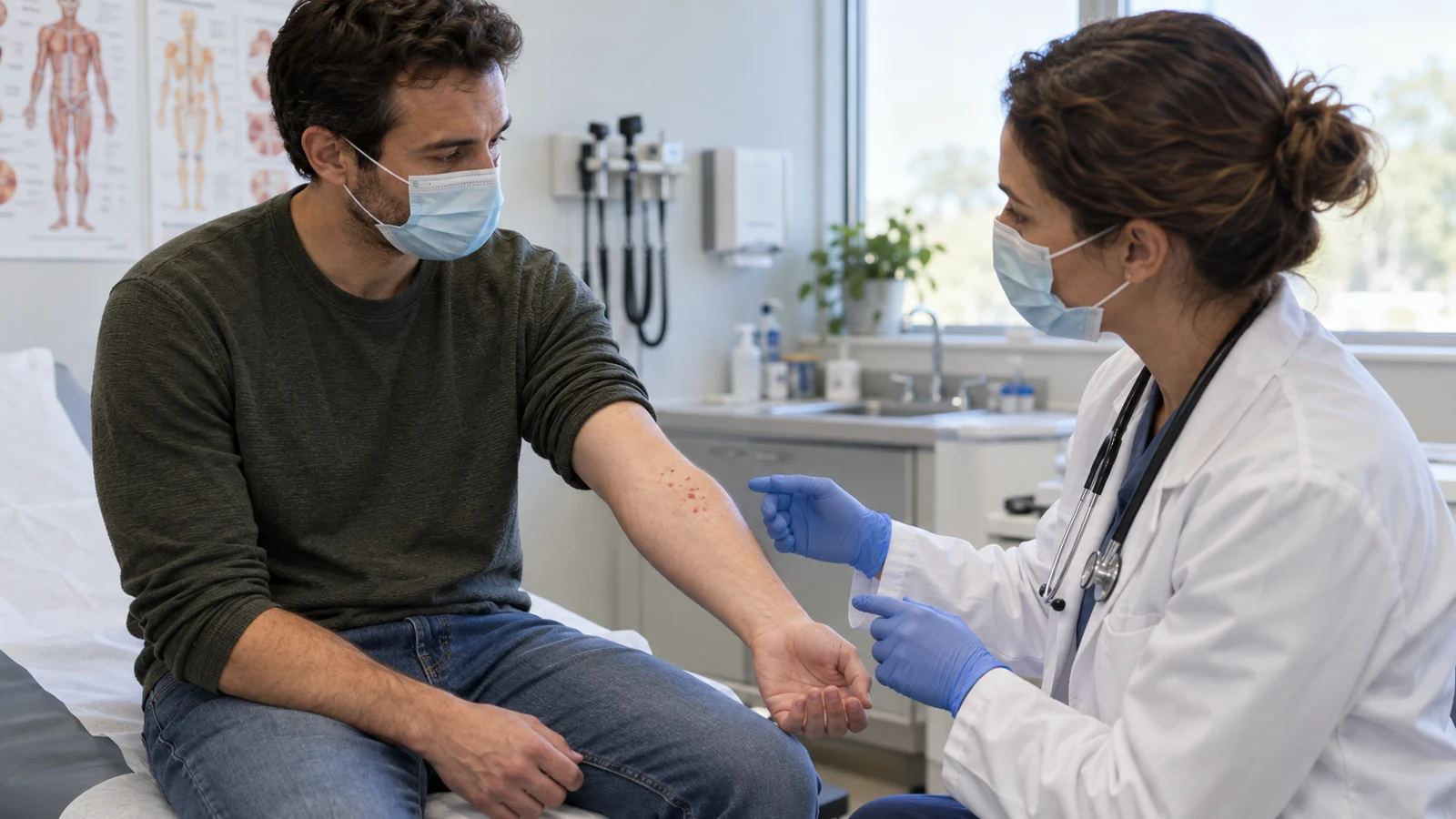
Mpox, formerly known as monkeypox, is a contagious disease caused by a virus related to the smallpox virus. According to the Turkish Ministry of Health's M-Çiçeği Rehberi (Mpox Guide), it begins with fever, severe headache and swollen lymph nodes. This is followed by a rash that turns into fluid-filled blisters and then crusts over. In most people, the illness clears up on its own in 2–4 weeks. If you have a rash and have had a risky contact, wear a mask, call ahead, and see a physician.
Short Answer
Mpox, formerly known as monkeypox, is a contagious disease caused by a virus related to the smallpox virus. According to the Turkish Ministry of Health's M-Çiçeği Rehberi (Mpox Guide), it begins with fever, severe headache and swollen lymph nodes. This is followed by a rash that turns into fluid-filled blisters and then crusts over. In most people, the illness clears up on its own in 2–4 weeks. If you have a rash and have had a risky contact, wear a mask, call ahead, and see a physician.
What are the symptoms?
According to the Ministry of Health guide, the incubation period is usually 6–14 days, but it can range from 1 to 21 days. The incubation period is the time from contact with the virus to the first symptom.
The prominent symptoms in the first 5 days are:
- Fever and chills.
- Severe headache.
- Swollen lymph nodes (lymphadenopathy) in the neck, armpit or groin.
- Back and muscle pain.
- Marked fatigue.
According to the guide, the skin rash usually begins 1–3 days after the fever. According to World Health Organization (WHO) data, the most common finding in patients after 2022 was rash (88.5%). This was followed by fever (57.9%) and rash in the genital area (49.5%). Lymph node enlargement was reported in 29.9% of patients. So fever does not occur in every patient; in some people the first thing noticed is the rash.
How does the rash progress?
The Ministry of Health guide lists the stages of the rash as follows:
- Macule: A flat, red spot.
- Papule: A slightly raised, firm bump.
- Vesicle: A blister filled with clear fluid.
- Pustule: A blister filled with yellowish fluid.
- Crust: A scab that dries and then falls off.
The number of lesions can range from a few to several thousand. The rash can appear on the face, palms, soles of the feet, inside the mouth, the genital area and around the anus. According to WHO, the lesions can be itchy or painful. A person is considered contagious until the crusts fall off and new skin forms underneath.
How is it transmitted?
According to WHO, mpox is mostly transmitted through close contact with an infected person. This includes household members. Close contact covers:
- Skin-to-skin contact: touching, hugging, massage, sexual intercourse.
- Mouth-to-mouth or mouth-to-skin contact.
- Prolonged face-to-face presence at close range.
- Sheets, towels and clothes that have touched the sores.
- From mother to baby during pregnancy or childbirth.
In Africa, bites or scratches from infected animals or contact with their meat are also a route of transmission. According to the Ministry of Health guide, the risk is highest among people sharing the same home and unprotected caregivers. Short-term social contact on a plane or bus is not considered high risk.
What is the difference between clade I and clade II?
The mpox virus has two main genetic branches (clades): clade I (Ia and Ib) and clade II (IIa and IIb). The outbreak that spread worldwide in 2022 was caused by clade IIb. According to the Ministry guide, clade I, originating in Central Africa, caused more severe disease in the past.
Clade Ib increased after 2023 in the Democratic Republic of the Congo and surrounding areas. According to WHO's June 2026 situation report, local transmission of clade Ib was reported in Spain and Thailand. In October 2025, the WHO Emergency Committee noted that deaths from clade Ib remained low. Deaths occurred mostly in people with weakened immune systems.
Current situation: is the global outbreak alert still in effect?
No. WHO declared mpox a public health emergency of international concern in August 2024. Following a sustained decline in cases, this declaration ended on September 5, 2025. This does not mean the disease is over. In June 2026, WHO was still monitoring the outbreak as an emergency in its own internal grading.
According to WHO's report dated June 26, 2026, 1,142 confirmed cases were reported from 32 countries in May 2026. Three deaths were recorded in the same month. WHO is asking countries to continue surveillance and reporting.
How is it different from chickenpox?
The mpox rash can resemble chickenpox. According to the Ministry guide and the Turkish Medical Association (Türk Tabipleri Birliği) information note, the following clues help distinguish them:
- Swollen lymph nodes: Prominent in mpox and may appear before the rash. Not as prominent in chickenpox and measles.
- Distribution: The mpox rash is concentrated more on the face, arms and legs than on the trunk; it can involve the palms and soles.
- Stages: In the Ministry's case definition, the lesions are at the same period, that is, at the same stage.
A definitive distinction cannot be made at home. The diagnosis is made by a PCR test on a sample taken from lesion fluid or crust. Diagnosis by blood test is often not possible.
Treatment and home care
According to the Ministry of Health guide, mpox is a self-limiting disease in most people. The basis of treatment is relieving symptoms and preventing complications. The home care steps recommended by WHO are:
- Do not scratch the lesions; keep the skin dry and uncovered when you are alone.
- Keep the rash clean with sterile water or an antiseptic.
- Gargle with salt water for mouth sores.
- You can take a warm bath for the discomfort of sores on the body.
- Drink plenty of fluids; for pain and fever, use the medication your physician recommends.
There is currently no drug specific to mpox with proven efficacy. Details are in the "What does the evidence say?" section.
What should you not do?
- Do not pop or scratch the blisters. WHO recommends avoiding scratching; the skin may become infected with bacteria.
- Do not start antibiotics on your own. If a sore is inflamed, a physician should evaluate it and choose the treatment.
- Do not go to an outpatient clinic unannounced. Call first; the Ministry guide asks suspected cases to wear a mask.
- Do not share towels, sheets or clothes. The NHS clearly recommends this.
- Do not have sex until you have recovered. WHO recommends using condoms for 12 weeks after recovery as well.
- Do not buy antivirals or "pox medicine" online. Products without evidence can cause harm.
How is isolation done?
According to WHO, the sick person should stay isolated at home from the start of symptoms until the sores heal and the crusts fall off. The Ministry guide sets isolation for a probable case at 21 days after the day the first lesion appeared. The guide's recommendations for home isolation are:
- Stay in a separate room; do not let your belongings leave the room.
- If possible, use a separate bathroom and toilet.
- Wipe common areas with a solution containing at least 60% alcohol or 1% bleach.
- If you are in the same room as others, wear a mask and cover the lesions with clothing.
- Wash sheets, towels and underwear at a minimum of 60 degrees.
- Clean with damp methods that do not raise dust into the air.
Contacts should monitor themselves for fever and rash for 21 days after the last contact.
Who gets the vaccine?
According to WHO, the mpox vaccine is recommended for people at high risk, especially during an outbreak. These are health workers, people living in the same home as a patient, and people with multiple sexual partners. Post-exposure vaccination is given within the first 4 days if possible, and no later than 14 days if there are no symptoms.
According to the Ministry guide and the Turkish Medical Association, the vaccine based on the modified Ankara strain was approved in the US (FDA) in 2019. The guide states that as of 2024 access to the vaccine was limited. WHO recommends the vaccine not for everyone but for those at high risk. Discuss your needs with an Infectious Diseases specialist.
What does the evidence say?
- Tecovirimat (antiviral): The PALM007 randomized controlled trial, conducted in the Congo and published in 2025, enrolled 597 patients. The drug did not speed up healing of sores compared with placebo in clade I patients. No safety issues were seen.
- Other antivirals: According to the Ministry guide, the effect of available drugs has not been shown in randomized trials. Positive data are only at the case level.
- Old smallpox vaccine: According to the Ministry guide, in several observational studies the smallpox vaccine prevented mpox at a rate of about 85%. These data belong to the period when the vaccine was given routinely.
- Blood and antibody tests: According to the Ministry guide, antibody tests are not used for diagnosis because they cross-react among poxviruses. The correct test is PCR on a lesion sample.
- Herbal and "natural" treatments: WHO and the Ministry guide mention supportive care and antivirals for treatment. Neither recommends herbal products or supplements.
In Türkiye
- Reporting is mandatory: According to the Ministry guide, health institutions report probable or confirmed cases to the provincial health directorate. The provincial health directorate forwards them the same day to the General Directorate of Public Health.
- Diagnostic test: PCR samples are processed in connection with the National Virology Laboratory of the General Directorate of Public Health. This test is not done in routine laboratories.
- Smallpox vaccine: In Türkiye, the smallpox vaccine was given routinely until 1980. According to the Ministry guide, people who received this vaccine may be protected against mpox to some degree.
- The Ankara connection: According to the Turkish Medical Association, the Ankara strain underlying the vaccine was derived from the smallpox vaccine strain developed at the Refik Saydam Hıfzıssıhha Institute.
- Access to the vaccine: For information about the vaccine, consult your family physician or an Infectious Diseases outpatient clinic.
Which doctor should you see?
- First step: Call your family physician or the hospital by phone first; go wearing a mask.
- Infectious Diseases: For diagnosis, isolation and contact monitoring.
- Dermatology: To distinguish the rash from other diseases.
- For children: Pediatrics.
- Bring with you: The day symptoms began, the day the rash began, and information on travel and close contacts in the last 3 weeks.
When should you seek emergency care?
- If there is shortness of breath, confusion or a seizure, call 112 (the emergency number in Türkiye).
- If there is eye pain, redness or blurred vision, go to the emergency department without waiting.
- If you cannot swallow or take fluids because of mouth and throat sores, go to the emergency department without waiting.
- If you have severe vomiting or diarrhea and reduced urination, go to the emergency department without waiting.
- If there is spreading redness, swelling, pus in the sores and high fever, see a physician the same day.
- If there is severe pain or bleeding around the anus, see a physician the same day.
- If mpox is suspected in a baby, a pregnant woman or someone with a weakened immune system, see a physician the same day.
When going to the emergency department, wear a mask, cover the lesions and, if possible, call ahead.
Related guides
- What causes swollen lymph nodes?
- Sexually transmitted infection tests
- Mpox vaccine recommendation for travelers
- New mpox cases in Europe and a vaccine warning
- Mpox risk in advanced HIV
- Symptom guides
What changed? (October 2026)
- New guide: WHO's ending of the global emergency in September 2025 and the June 2026 situation report were added.
- The 2024 version of the Turkish Ministry of Health's M-Çiçeği (Mpox) Rehberi was used as the basis.
- The PALM007 result for tecovirimat, published in 2025, was added.
Sources
- Turkish Ministry of Health, General Directorate of Public Health (T.C. Sağlık Bakanlığı Halk Sağlığı Genel Müdürlüğü). M-Çiçeği (Mpox) Rehberi. Version 2, August 2024. https://hsgm.saglik.gov.tr/depo/Yayinlarimiz/Rehberler/Mpox-Rehberi.pdf (accessed October 7, 2026)
- Türk Tabipleri Birliği. Mpox Hastalığına İlişkin Bilgi Notu. August 15, 2024. https://ttb.org.tr/userfiles/files/Maymun_Cicegi_Bilgi_Notu.pdf (accessed October 7, 2026)
- World Health Organization. Mpox (fact sheet). https://www.who.int/news-room/fact-sheets/detail/mpox (accessed October 7, 2026)
- World Health Organization. Mpox: questions and answers. October 16, 2024. https://www.who.int/news-room/questions-and-answers/item/mpox (accessed October 7, 2026)
- World Health Organization. Fifth meeting of the IHR (2005) Emergency Committee regarding the upsurge of mpox 2024. October 30, 2025. https://www.who.int/news/item/30-10-2025-fifth-meeting-of-the-international-health-regulations-(2005)-emergency-committee-regarding-the-upsurge-of-mpox-2024 (accessed October 7, 2026)
- World Health Organization. Multi-country outbreak of mpox, External situation report no. 67. June 26, 2026. https://cdn.who.int/media/docs/default-source/_sage-2026/multi-country-outbreak-of-mpox--external-situation-report_67.pdf (accessed October 7, 2026)
- PALM007 Writing Group. Tecovirimat for Clade I MPXV Infection in the Democratic Republic of Congo. N Engl J Med 2025;392(15):1484–1496. https://doi.org/10.1056/NEJMoa2412439 (accessed October 7, 2026)
- NHS. Mpox. Last reviewed April 9, 2026. https://www.nhs.uk/conditions/mpox/ (accessed October 7, 2026)
Frequently asked questions
How is monkeypox transmitted; is it airborne?
According to WHO, the main route of transmission is close skin-to-skin and oral contact. It can also pass through the respiratory route with prolonged face-to-face contact. The Ministry guide does not consider short-term social contact high risk.
How many days does mpox take to go away?
According to the Ministry of Health guide, symptoms usually last 2–4 weeks. Contagiousness ends when the crusts fall off and new skin forms. The duration may be longer in people with weakened immune systems.
Is there a monkeypox vaccine?
Yes. WHO recommends the vaccine for people at high risk, especially during an outbreak. Vaccination is not recommended for everyone. According to the Ministry's 2024 guide, access was limited; consult your physician for the current situation.
Is mpox deadly?
Most people recover on their own. According to WHO, children, pregnant women and people with weakened immune systems are at higher risk of severe disease. People with uncontrolled HIV infection are also in this group.
Is mpox transmitted only sexually?
No. Although sexual contact is an important route, it is also transmitted through close contact within the household. WHO reported that transmission starting in sexual networks spread into households. In some regions, all age groups were affected.
Source: T.C. Sağlık Bakanlığı Halk Sağlığı Genel Müdürlüğü. M-Çiçeği (Mpox) Rehberi. Sürüm 2, Ağustos 2024.