Kitchen Medicine
What Should People with Diabetes Eat? Nutrition in Type 2 Diabetes
In type 2 diabetes, half the plate should be vegetables, a quarter protein and a quarter whole grains; the drink should be water. People who use insulin should not skip meals.
Translated from the Turkish original by DoktorClub. The Turkish version is the reference text; this English translation has not been separately reviewed by a physician. Read the Turkish original.
Key takeaway
There is no single "right diet" for diabetes; the plan is tailored to the person. In the plate model in the American Diabetes Association's (ADA) 2026 standards, half the plate is non-starchy vegetables, a quarter is protein and a quarter is carbohydrate. The TEMD 2026 guideline emphasizes whole grains, legumes, vegetables, whole fruit and low-fat dairy products. Make water your main drink; give up sugary drinks and fruit juice. If you use insulin or certain glucose-lowering pills, do not skip meals.
Short Answer
There is no single "right diet" for diabetes; the plan is tailored to the person. In the plate model in the American Diabetes Association's (ADA) 2026 standards, half the plate is non-starchy vegetables, a quarter is protein and a quarter is carbohydrate. The TEMD 2026 guideline (Society of Endocrinology and Metabolism of Turkey) emphasizes whole grains, legumes, vegetables, whole fruit and low-fat dairy products. Make water your main drink; give up sugary drinks and fruit juice. If you use insulin or certain glucose-lowering pills, do not skip meals.
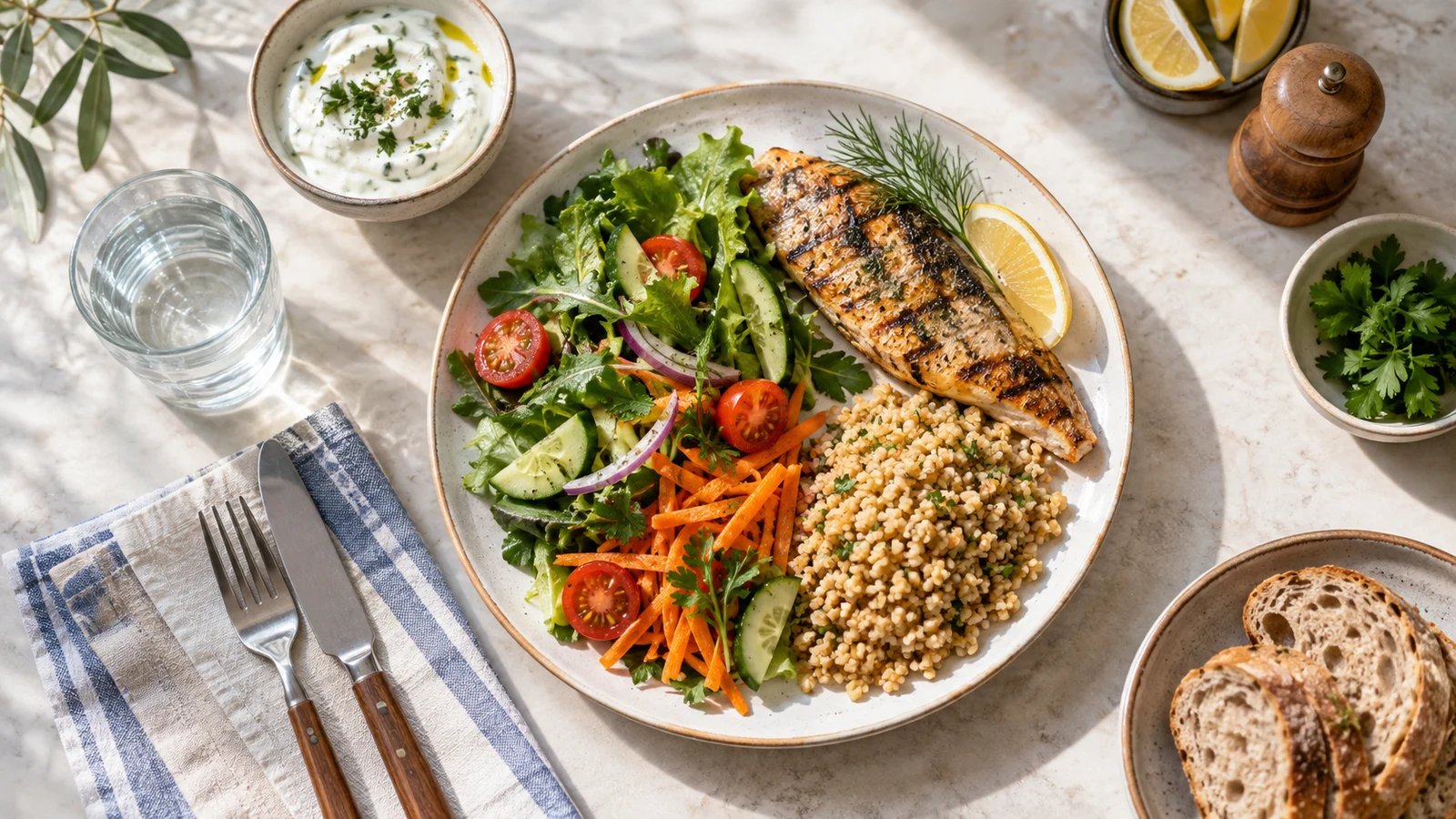
The plate model: How should you fill your plate?
The ADA recommends the plate model (plate method) as a simple, visual meal-planning tool. In a randomized study, both the plate model and carbohydrate counting improved HbA1c. TEMD also considers this method suitable for people who have just been diagnosed and those who eat out often.
- Half the plate: Non-starchy vegetables. Examples: green beans cooked in olive oil, spinach, leeks, zucchini, okra, salad.
- A quarter of the plate: Protein. Examples: fish, chicken, eggs, low-fat cheese.
- A quarter of the plate: Carbohydrate. Examples: bulgur pilaf, whole wheat bread, a legume dish.
- On the side: Water; a bowl of yogurt if you like.
Legumes contain both carbohydrate and protein. Place chickpea, lentil or white bean dishes in the carbohydrate section of the plate. ADA 2026 recommends increasing plant proteins such as hazelnuts, walnuts, seeds and legumes to reduce cardiovascular risk.
Carbohydrates: Bread, rice, bulgur and fruit
There is no need to cut out carbohydrates completely. According to TEMD 2026, daily carbohydrate should be at least 130 grams. The guideline does not recommend diets that go below this limit. ADA 2026, on the other hand, considers reducing carbohydrates an option for some adults. According to the ADA, the effective way to do this is to cut back on processed foods. Decide with your dietitian which approach suits you.
Quality matters as much as quantity:
- Fiber: ADA 2026 and TEMD 2026 recommend at least 14 grams of fiber per 1000 calories.
- Grain choice: The Turkey Dietary Guidelines (TÜBER 2022) recommend whole grain products instead of white bread, and bulgur pilaf instead of rice.
- Fruit: TEMD recommends whole fruit instead of fruit juice. Fruit juice is used only to treat low blood sugar.
- Routine: People on fixed insulin doses should eat a similar amount of carbohydrate at similar times every day.
Bread, rice and pasta are not forbidden; the portion and type matter. For examples from Turkish cuisine, see our guide to glycemic load in Turkish cuisine.
What should you limit? Sugar, sweeteners, salt and alcohol
Sugary drinks: ADA 2026 recommends replacing sugary drinks, including fruit juices, with water or calorie-free drinks. TEMD also asks that water be drunk instead of sugary drinks.
Added sugar: According to the World Health Organization (WHO), free sugars should not exceed 10% of daily energy. In a 2000-calorie diet, this is about 50 grams. Going below 5% may provide additional benefit. According to TÜBER, honey also counts as free sugar.
Sweeteners: The ADA says calorie-free sweeteners can be used in moderation and for a short time in place of sugary products. The WHO's 2023 guideline does not recommend sweeteners for weight control. However, the WHO explicitly states that this recommendation does not cover people with diabetes. In either case, the best drink is water.
Salt: ADA 2026 recommends keeping daily sodium below 2300 mg. The WHO recommends less than 5 grams of salt per day for adults. Pickles, brined foods, instant soups and processed meats quickly increase salt intake.
Alcohol: TEMD 2026 does not recommend alcohol for people with diabetes. The ADA also asks those who do not drink not to start. For someone who drinks, TEMD's limit is 1 unit per day for women and 2 units per day for men. It should not exceed 2 days a week. One unit is 360 mL of beer or 150 mL of wine. Alcohol can lower blood sugar even hours later. People who use insulin or pills that stimulate insulin secretion should take alcohol with food.
Low blood sugar (hypoglycemia) risk in people on medication
According to TEMD, below 70 mg/dL is the threshold for low blood sugar in people with diabetes. The risk is highest in people using insulin and sulfonylurea pills. TEMD recommends that these people not skip meals and always include carbohydrate in their meals. Carry sugar cubes with you during exercise.
For a person who is conscious and able to swallow, TEMD recommends the following steps:
- Take 15–20 grams of fast-acting sugar: 3–4 glucose tablets, 4–5 sugar cubes or 150–200 mL of fruit juice.
- Do not use fatty products such as chocolate and wafers; they raise blood sugar slowly.
- A response should be seen within 10–20 minutes; if there is no improvement, additional treatment is needed.
- TEMD recommends measuring blood sugar again after 1 hour.
- If the next meal is more than half an hour away, add 15–20 grams of complex carbohydrate.
- If you take acarbose, choose glucose tablets or gel instead of sugar cubes.
Do not give anything by mouth to a person who is confused or unable to swallow, and call 112 (the emergency number in Türkiye). For the symptoms of low blood sugar, see our hypoglycemia guide.
Ramadan and fasting: When should you consult a physician?
TEMD 2026 recommends that a person with diabetes who wants to fast see a physician 4–8 weeks before Ramadan. The physician determines your risk group and adjusts your medicines if needed. According to TEMD, people in the very high and high risk groups should not fast. This group includes people with type 1 diabetes, pregnancy, dialysis and those with severe or recurrent low blood sugar.
- While fasting, check your blood sugar more often than usual.
- If your blood sugar is below 70 mg/dL with symptoms, break the fast immediately.
- At iftar, split the meal rather than eating a lot at once, and drink enough fluids.
- Do not change the timing or dose of your medicine on your own.
What not to do?
- Stopping medicine because "I'll manage with diet": Nutrition is part of treatment; it does not replace medicine on its own. Discuss any medication change with your physician.
- Skipping meals: In people using insulin and sulfonylureas, skipping meals can lower blood sugar (TEMD 2026).
- Treating honey and grape molasses as unrestricted because they are "natural": According to TÜBER, honey is also a free sugar.
- Counting fruit juice as a healthy drink: The ADA recommends limiting fruit juices along with sugary drinks.
- Trying to correct low blood sugar with chocolate: TEMD does not recommend fatty products for this purpose.
- Relying on cinnamon, turmeric or chromium pills: TEMD and the ADA do not recommend supplements to lower blood sugar.
- Starting a ketogenic diet while taking an SGLT2 inhibitor: ADA 2026 does not recommend a ketogenic diet in these people because of the risk of ketoacidosis.
What does the evidence say?
According to TEMD 2026, nutrition therapy with a dietitian can lower HbA1c by 0.3% to 2% in type 2 diabetes. This effect is close to that of some medicines. The ADA targets at least 5–7% weight loss in people with excess weight. According to TEMD, weight loss of more than 10% can reverse the disease in type 2 diabetes (remission).
The TEMD guideline, which evaluates studies and meta-analyses, considers the Mediterranean and DASH dietary patterns evidence-based. According to the guideline, the other diets have no clear superiority over one another. Most short-term benefits come from calorie reduction. In observational studies, yogurt, nuts and seeds, coffee and tea are associated with a lower risk of diabetes. These findings do not prove cause and effect.
Most popular "blood sugar-lowering food" claims are not supported. ADA 2026 does not recommend supplements such as magnesium, chromium, cinnamon and aloe vera for blood sugar. TEMD also states that the evidence for cinnamon, turmeric and vitamin D is insufficient.
In Türkiye
- Eating habits: TEMD 2026 cites data from the Turkey Nutrition and Health Survey. According to these data, 51% of energy in men and 50% in women comes from carbohydrates.
- Fiber shortfall: According to TÜBER 2022, in the same survey 67.2% of people aged 15 and over consumed less fiber than recommended.
- Dietitian support: At the Turkish Ministry of Health's Healthy Life Centers, dietitians provide nutrition counseling to people with chronic diseases such as diabetes. Your family physician can refer you to such a center.
- Kitchen tip: TÜBER recommends increasing legume consumption and choosing whole vegetables. Vegetable dishes cooked in olive oil are a good foundation in this respect.
- Emergencies: In case of loss of consciousness, seizure or breathing difficulty, call the 112 Emergency Call Center.
Which doctor should you see?
- First step: Your family physician. They review your tests and refer you to a dietitian.
- Specialist follow-up: Internal Medicine or Endocrinology and Metabolism.
- Nutrition plan: A dietitian. The ADA and TEMD recommend that everyone with diabetes be referred to a dietitian.
- Pregnancy or planning a pregnancy: Obstetrics and Gynecology together with Endocrinology.
- Bring with you: Your latest HbA1c and blood sugar readings, a 3-day food diary and a list of the medicines you use.
When to seek emergency care?
- If low blood sugar is accompanied by confusion, a seizure or inability to swallow, call 112. Do not give food or drink by mouth.
- If low blood sugar does not improve despite taking fast-acting sugar, or recurs within a short time, call 112.
- If high blood sugar is accompanied by nausea, vomiting, abdominal pain, rapid deep breathing or an acetone smell on the breath, call 112. These may be signs of ketoacidosis.
- If you are taking an SGLT2 inhibitor and develop vomiting and abdominal pain, go to the emergency department without waiting, even if your blood sugar is normal.
- If you have chest pain, sudden difficulty speaking or facial drooping, call 112.
Related guides
- What should fasting blood sugar be?
- What should blood sugar be after meals?
- What should HbA1c be? Results table
- Signs of hidden diabetes (prediabetes)
- Symptoms of type 2 diabetes
- What are the symptoms of hypoglycemia?
- Glycemic load in Turkish cuisine
- Kitchen Medicine and Metabolism guides
What changed? (October 2026)
- New guide: prepared according to the TEMD 2026 Diabetes Mellitus guideline and the ADA 2026 Standards of Care.
- It is stated explicitly that the WHO's 2023 sweetener recommendation does not cover people with diabetes.
Sources
- Türkiye Endokrinoloji ve Metabolizma Derneği (TEMD). Diabetes Mellitus ve Komplikasyonlarının Tanı, Tedavi ve İzlem Kılavuzu. 2026 (17th edition). https://file.temd.org.tr/Uploads/publications/guides/documents/diabetesmellitus2026.pdf (accessed October 7, 2026)
- T.C. Sağlık Bakanlığı, Halk Sağlığı Genel Müdürlüğü. Türkiye Beslenme Rehberi (TÜBER) 2022. Publication No 1031. https://hsgm.saglik.gov.tr/depo/birimler/saglikli-beslenme-ve-hareketli-hayat-db/Dokumanlar/Rehberler/Turkiye_Beslenme_Rehber_TUBER_2022_min.pdf (accessed October 7, 2026)
- T.C. Sağlık Bakanlığı, Halk Sağlığı Genel Müdürlüğü. Sağlıklı Hayat Merkezleri Rehberi. May 22, 2025. https://hsgm.saglik.gov.tr/depo/Shm_Rehber_22.05.2025.pdf (accessed October 7, 2026)
- American Diabetes Association Professional Practice Committee. 5. Facilitating Positive Health Behaviors and Well-being to Improve Health Outcomes: Standards of Care in Diabetes—2026. Diabetes Care 2026;49(Suppl 1):S89–S131. https://doi.org/10.2337/dc26-S005 (accessed October 7, 2026)
- World Health Organization. Healthy diet (fact sheet). January 26, 2026. https://www.who.int/news-room/fact-sheets/detail/healthy-diet (accessed October 7, 2026)
- World Health Organization. Use of non-sugar sweeteners: WHO guideline. 2023. https://www.who.int/publications/i/item/9789240073616 (accessed October 7, 2026)
- World Health Organization. WHO advises not to use non-sugar sweeteners for weight control in newly released guideline. May 15, 2023. https://www.who.int/news/item/15-05-2023-who-advises-not-to-use-non-sugar-sweeteners-for-weight-control-in-newly-released-guideline (accessed October 7, 2026)
- T.C. İçişleri Bakanlığı. 112 Acil Çağrı Merkezi. 2026. https://www.112.gov.tr/ (accessed October 7, 2026)
Frequently asked questions
Can people with diabetes eat bread?
Yes, they can. What matters is the amount and the type. TÜBER (Türkiye's national dietary guidelines) recommends whole grain bread instead of white bread. Count bread in the carbohydrate quarter of the plate model. If the same meal also includes rice, the two together should fill this quarter.
Which fruits can people with diabetes eat?
Fruit is not forbidden; TEMD prefers whole fruit to fruit juice. Eat fruit spread across meals rather than in a large amount at once. Fruit juice contains no fiber; TEMD reserves it for treating low blood sugar. Determine the amount with your dietitian.
Are honey and grape molasses harmless for people with diabetes?
No, they are not harmless. According to TÜBER, honey is a free sugar and should be limited like table sugar. The WHO recommends that free sugars not exceed 10% of daily energy.
Can people with diabetes use sweeteners?
According to ADA 2026, they can be used in moderation and for a short time in place of sugary products. The WHO's 2023 sweetener recommendation does not cover people with diabetes. Still, the ADA stresses that the healthiest drink is water.
How many meals a day should people with diabetes eat?
There is no fixed number for everyone. According to TEMD, the number of meals is determined by your medicine, your type of insulin and your daily routine. If you use insulin or a sulfonylurea, it is important not to skip meals.